

Introducing Time-Based Metadata: Unlocking a new layer of data in media forensics
Key takeaways
- Time-based metadata is dynamic, frame-specific data — like GPS, speed, and object positions — that evolves across a file’s timeline, unlike traditional metadata.
- This data has existed in files for years but has stayed hidden, buried in proprietary structures that require specialized parsing to access.
- Magnet Verify is the only forensic tool that identifies, decodes, and exposes time-based metadata, giving examiners frame-level precision for cases like use-of-force investigations and crash reconstruction.
When most forensic practitioners think about metadata, they think in terms of static attributes — simple key/value pairs that describe a file at a high level.
We use this data every day. Things like:
- Duration: 1 min 51 s
- Encoded date: UTC 2026-06-23 18:48:47
- Resolution: 1920 × 1080
- Frame rate: 29.605 FPS
This is the metadata we’ve relied on for years. It’s useful, foundational, and reliable. But it only tells part of the story. What if investigators could leverage not just the data that describes the file, but data that describes every moment within it?
A shift from static to dynamic metadata
Enter a new concept: time-based metadata. Unlike traditional metadata, time-based metadata isn’t fixed. It’s dynamic, frame-specific data that evolves across the timeline of a media file.
In video and audio, every frame or sample represents a unique moment. When present, time-based metadata carries its own embedded data that can help describe where something was at a particular time, when exactly an event occurred, how objects or people moved, and/or spatial relationships within the frame.
From GPS and speed to facial bounding boxes shown on playback, this metadata is tied directly to time, and often to position within the image itself — making it both temporal and spatial.
What does time-based metadata look like in practice?
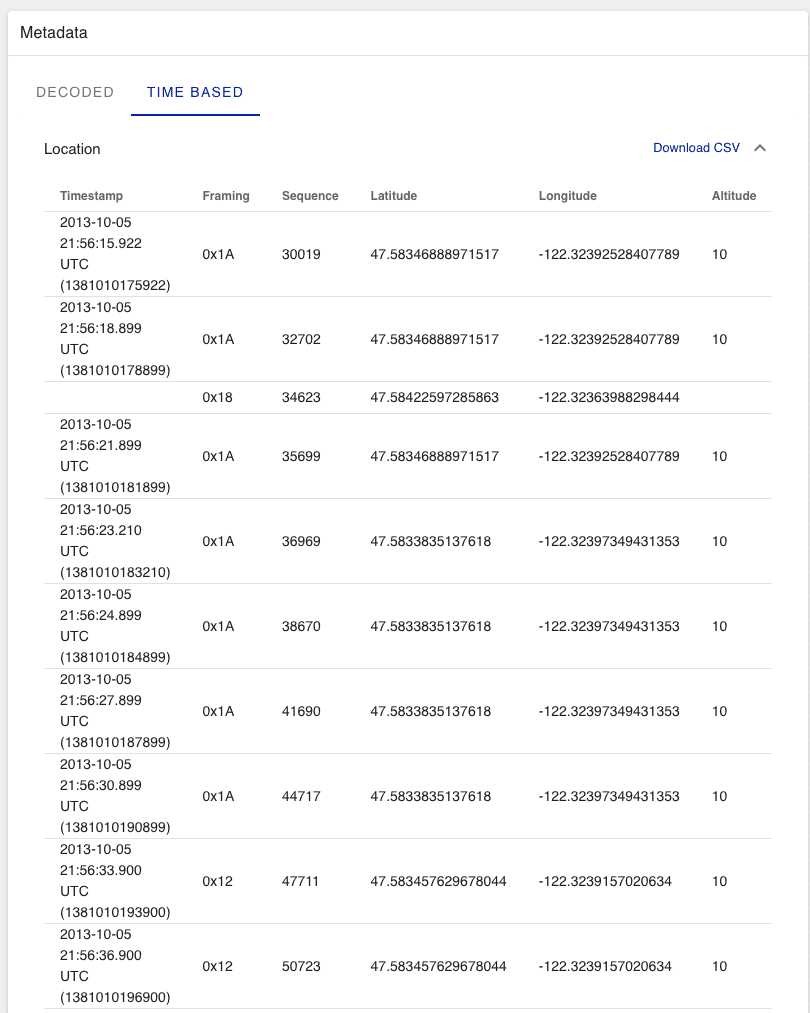
Imagine a body-worn camera recording. Instead of a single GPS coordinate for the file, the video may contain thousands of location samples, each tied to a specific point in time:
| Timestamp | Latitude | Longitude | Altitude | Speed |
|---|---|---|---|---|
| 21:56:15.922 UTC | 47.58347 | -122.324 | 10 | 35.0 |
| 21:56:18.899 UTC | 47.58347 | -122.324 | 10 | 35.0 |
This isn’t just metadata; it’s a highly descriptive timeline of movement. And it isn’t just for GPS coordinates and speed. Time-based metadata could include information about object detection bounding boxes, facial recognition overlays, and offer timecode precision beyond visible timestamps.
Why time-based metadata matters for forensic examinations
Time-based metadata can make all the difference in examinations where it matters most. Because it’s granular and time-aligned, it enables analysis that simply wasn’t possible with traditional metadata alone:
- Use-of-force investigations
Reconstruct exact movement, speed, and positional changes second-by-second. - Crash reconstruction
Map vehicle trajectory, acceleration, and environmental context directly from embedded telemetry. - Event validation
Correlate multiple data streams with precise temporal alignment — rather than relying on approximations.
Why time-based metadata has been hidden until now
Time-based metadata has been embedded in files for years but has been largely inaccessible. Why? Because it’s not stored like traditional metadata. Instead, it lives in:
- Proprietary data structures inside media containers (e.g., body camera MP4 files)
- Embedded sample tracks within formats like MOV and MP4
- Data streams buried deep inside where video frames are stored (e.g. “mdat” and “trak” boxes)
Extracting and interpreting this data requires specialized parsing logic, often tailored to specific devices and manufacturers. It’s not something generic tools can easily surface.
Unlocking time-based metadata with Magnet Verify
This is where Magnet Verify breaks new ground. Magnet Verify is currently the only forensic tool that identifies, decodes, and exposes time-based metadata using custom-built parsers designed specifically for these complex data structures.
When present, Verify will detect time-based data and extract all data within each frame. Inside Verify, this appears as a dedicated “Time-based Metadata” tab, giving examiners direct access to this otherwise hidden layer of evidence. Time-based metadata is also available for download as a CSV for further analysis and/or reporting.
Why time-based metadata is treated differently
Unlike standard metadata, time-based metadata isn’t a simple list. It’s a dataset of hundreds, thousands, or even millions of entries, each tied to a specific moment in time. That’s why Verify delivers it as high-fidelity granular data rather than forcing it into traditional key/value fields.
Leading the way forward
Magnet Verify has consistently pushed the boundaries of what’s possible in media forensics. With the introduction of time-based metadata parsing and decoding, it does so again, bringing visibility to a class of evidence that has, until now, remained largely untapped.
Time-based metadata represents a shift in how we approach digital evidence — from static summaries to frame-level precision. For examiners working complex, high-stakes cases, it’s a new layer of evidence that’s finally within reach.
Watch our Introduction to Magnet Verify webinar to see how forensic examiners analyze digital files, evaluate authenticity, and uncover valuable provenance insights.