

Bringing C2PA to the desktop: Enhancing media analysis in Magnet Verify
Key takeaways
- C2PA support is now built into Magnet Verify Desktop, letting you detect, extract, and validate embedded provenance data without external tools or manual workflows. Note: The Magnet Verify SaaS offering already supports C2PA.
- When present in a file, think of C2PA as a “nutrition label for media,” recording a file’s origin, edit history, tools used, and whether AI was involved
- C2PA is a signal, not a verdict. The presence of C2PA doesn’t guarantee whether the content is true, and its absence doesn’t imply that it was not AI-generated.
- Adoption is still early, but with major tech companies, AI platforms, and device makers integrating the standard, provenance signals will play an increasing role in forensic analysis.
As digital evidence continues to come from a growing range of devices, platforms, and creation tools, understanding a file’s origin and history is becoming an increasingly important part of media analysis and establishing trust in that evidence is becoming harder.
That leaves you with a critical question:
Can you reliably determine where a piece of media came from, and what’s happened to it along the way?
Magnet Verify’s file authentication capabilities now include support for C2PA, adding another layer of provenance data to evaluate as part of your analysis, without relying on external tools or manual workflows. Within Verify, C2PA is one of many data points you can assess, complementing structural, similarity, encoding, and metadata-based analysis to help you build a more complete understanding of the file.
What is C2PA and why does it matter?
C2PA (Coalition for Content Provenance and Authenticity) is an open technical standard that defines how to embed cryptographically signed metadata into media files, allowing users to inspect a file’s origin, edit history, and any declared transformations.
Often described as a “nutrition label for media,” C2PA provides a structured record of:
- Content origin and authorship: who created the file and where it came from
- Creation and modification details: what tools were used and what changes were made
- Integrity and AI indicators: whether AI was involved and if the file remains intact since signing
Importantly, C2PA doesn’t tell you whether a piece of content is “true.” When present, it gives you verifiable provenance signals that help you assess authenticity as part of your broader forensic analysis.
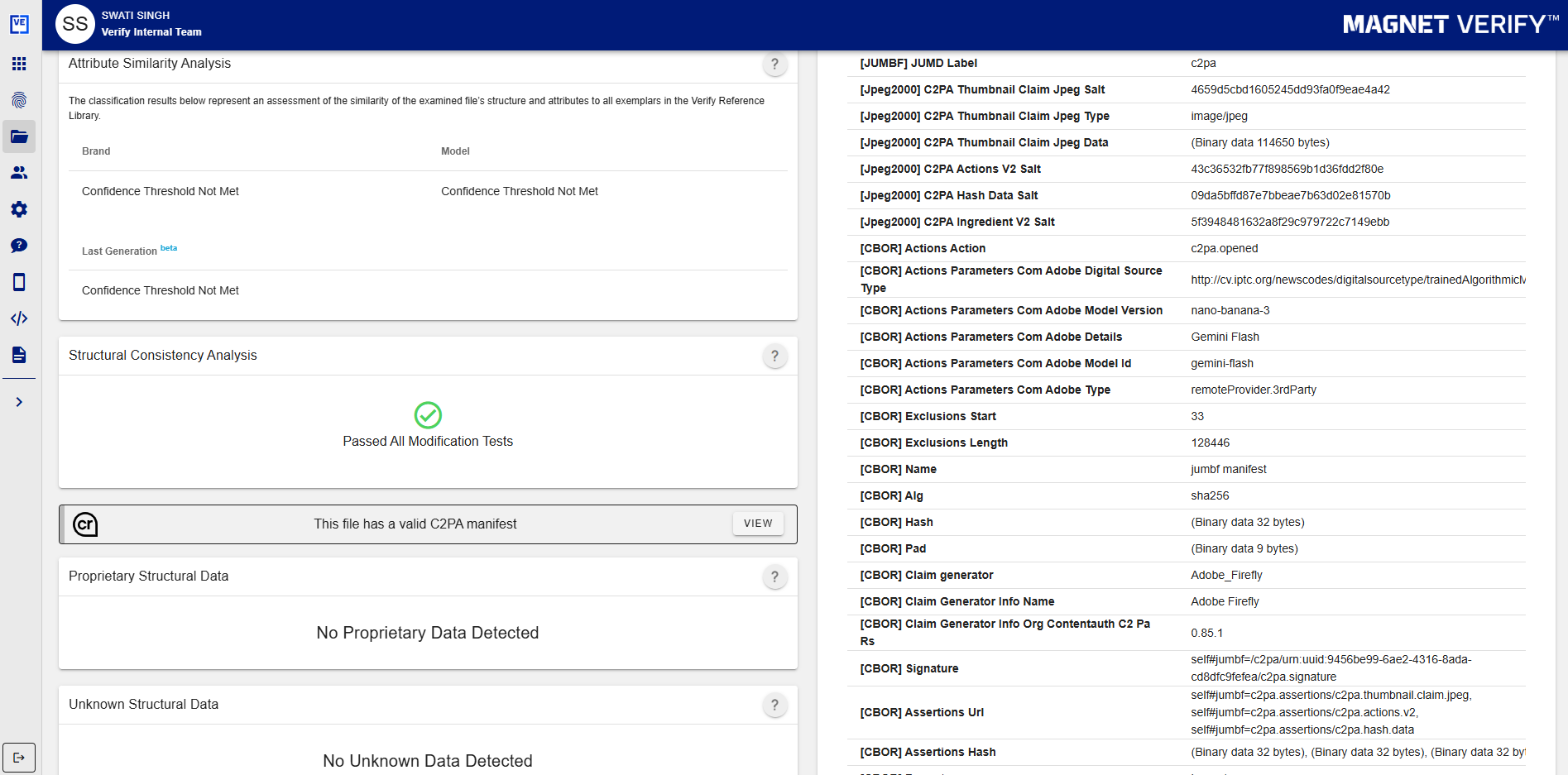
Accessing and analyzing C2PA data directly in your workflow
As you work through digital evidence, you’re increasingly encountering files that may contain embedded C2PA data — whether from AI-generated content, smartphones, or supported editing tools. But in practice, that doesn’t always make your job easier.
Often, you don’t even know whether the data is present. And when it is, accessing and validating it can mean jumping between tools or relying on scripts. That slows you down, introduces inconsistency into your workflow, and increases the risk of missing or misinterpreting potentially important provenance signals.
This is where C2PA support in Magnet Verify Desktop changes your experience.
Within your existing workflow, you can now automatically detect whether C2PA data exists in a file, removing the guesswork upfront. When it’s present, you can extract and review the underlying provenance information, including details about how the content was created, what tools were used, and what changes may have been made along the way.
To further support your analysis, you can validate the cryptographic signatures associated with that data. This helps you determine whether the provenance information is intact and trustworthy, giving you another signal to consider alongside other validation methods in Verify.
For deeper inspection, you also have access to raw C2PA data in a structured, human-readable format. This lets you move seamlessly between high-level interpretation and detailed technical validation, depending on what your investigation requires.
Remember that C2PA is a signal, and not a conclusion:
- C2PA is not a comprehensive media authentication solution
- Absence of C2PA does not indicate authenticity
- Presence of C2PA does not guarantee truthfulness
Treat C2PA as one of several signals that must be evaluated within a broader investigative context. It becomes especially valuable when you’re trying to understand how a file was created or modified. You may encounter this in scenarios such as:
- Media evidence authentication examinations
- Device-origin media analysis
- AI-generated content investigations
Preparing for a provenance-driven future
Today, you’ll find C2PA data in only a small fraction of the files you work with. Adoption is still evolving, and most files simply won’t include these credentials yet. But industry momentum is clear:
- Major technology companies are supporting the standard
- AI platforms are integrating content credentials
- Device manufacturers are embedding provenance signals at capture
As this ecosystem matures, the ability to detect and evaluate provenance signals like C2PA will become an important part of a broader forensic workflow.
With C2PA support built into Magnet Verify, you’re already equipped to work with these signals when they appear. You can start incorporating them into your workflow today, rather than adapting later when they become more common.
To learn more about C2PA in Magnet Verify, watch Cutting through the deepfake hype and read C2PA and media authentication: What you need to know