
Introducing the Magnet AI Research Lab: Our first peer-reviewed study puts AI in digital forensics to the test
Key takeaways:
- Magnet Forensics has launched the Magnet AI Research Lab, a dedicated program for applied AI research in digital forensics.
- The Research Lab’s first study, published in the Journal of Forensic Sciences, tested how accurately trained examiners and an AI expert system interpret media authentication results. The expert system scored 22 percentage points higher than the human average.
Every digital forensic examiner has been asked some version of the same question on the stand: how do you know?
It’s a fair question, and for most of the tools we use every day the answer depends on research somebody conducted and published. That isn’t a unique expectation. It applies to every forensic science, from firearms to toxicology, and just as squarely to the use of AI in digital forensics.
Today Magnet Forensics is launching the Magnet AI Research Lab: a dedicated program for research into the use of AI in digital forensics.
The Lab exists because that question is getting harder to answer. Courts have been weighing the reliability of novel science since before Daubert, and the questions haven’t gone away. The 2009 National Academy of Sciences report Strengthening Forensic Science in the United States found that, apart from nuclear DNA analysis, no forensic method had been rigorously shown to reliably connect evidence to a specific individual or source. The President’s Council of Advisors on Science and Technology (PCAST) reached a similar conclusion in 2016. The traditional disciplines named in those reports responded by doing the work. Digital forensics is moving in the right direction, but the road ahead is long, and the technology moves considerably faster.
AI didn’t create that gap. It turned the volume up on it.
Holding ourselves to the standard we are asking for
A good blog post or whitepaper can be genuinely informative and useful. It can explain a method clearly, share data, and help practitioners understand what a tool does and why. We publish plenty of them.
Proving that technology works is a different job. That’s why the Magnet AI Research Lab not only conducts research, but submits its studies to peer-reviewed journals, where independent reviewers decide whether the methodology holds. If the results don’t survive that process, they don’t get published. Once they are published, anyone can find the paper and review the study themselves.
What the Magnet AI Research Lab does
The Magnet AI Research Lab conducts and publishes its own research: studies on AI in digital forensics, which are submitted to peer-reviewed journals and conference proceedings so practitioners and courts can have confidence in the efficacy of results rather than take our word for it.
The Lab also partners on research with both practitioners and academics. A lot of excellent academic work never reaches the bench, not because it’s poor quality, but because it answers a different question than the one the examiner needed answered or never consults an examiner at all. Meanwhile, examiners face the questions that matter most without the methodology, statistical support, or the time to answer them. The Lab is designed to close that gap: helping with the research, the writing, and the publishing, or connecting an examiner to an academic partner who can.
The Lab is also a conduit. This is the part we most want people to hear. If you have a research question and genuinely don’t know where to start, you don’t need a methodology first. Come as you are, with the artifact that has been bothering you for years, and we’ll help you work out what the question actually is and who is best placed to answer it. The Lab’s first study shows what that looks like in practice.
Can AI interpret media authentication better than a human examiner?
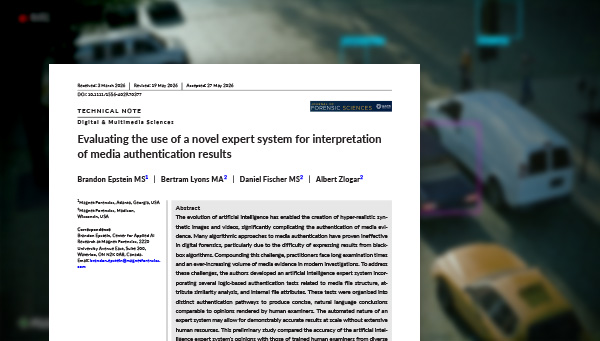
The study, published in the Journal of Forensic Sciences, is Evaluating the use of a novel expert system for interpretation of media authentication results, by Brandon Epstein, Bertram Lyons, Daniel Fischer, and Albert Zlogar.
It asked a deliberately narrow question. Media authentication answers questions like whether a photo or video is a genuine original, is an edited file, or synthetic media generated by AI — the deep end of the forensics pool, where the signals have to be read together before an examiner can say what a file really is. So, we built a test to find out who reads those signals more accurately: a trained human examiner, or the AI expert system inside Magnet Verify. Magnet Verify’s Automated Analysis, which is powered by AI, is used to confirm the authenticity of digital evidence through the analysis of hundreds of signals generated within Magnet Verify.
Here’s how it worked: 14 video files were created for the study, consisting of camera originals, edited files, social media files, AI-generated media, and a few designed specifically not to match anything in the Magnet Verify reference library.
We stripped out any automated analysis and Magnet Verify branding from the results, then asked trained, experienced examiners to provide an opinion about each file’s authenticity.
We then ran the same files through Magnet Verify’s automated analysis expert system and scored both the human and machine-generated responses against the ground truth data of the sample output.
The result
Across 20 respondents, the human mean was 69%. The expert system scored 91% — outperforming the human average by 22 percentage points.
Just as important as the score: the system didn’t return a single incorrect answer. Where the data didn’t support a confident call, it said so rather than guessing, which is exactly the behavior you want from a tool whose output might end up in front of a court.
The human results were revealing on their own. What predicted a high score wasn’t years on the job, it was specialized media authentication training. Experience alone showed no correlation at all. That says something about how hard this skill is to build and how thinly it’s spread across the field, which is a key reason a system that performs consistently matters.
How the headline result is framed matters, too. This isn’t a story about the machine being smarter than the examiner. These were layered, complicated results, and the expert system has a few unglamorous advantages: it doesn’t get tired, it doesn’t skip steps, and it is not biased by irrelevant case data. This isn’t replacing the examiner — it’s providing another tool to help produce accurate results.
Research paper
Evaluating the use of a novel expert system for interpretation of media authentication results
Published in the Journal of Forensic Sciences
Download nowPartner with the Magnet AI Research Lab
The Magnet AI Research Lab works with practitioners, agencies, and academic researchers to explore meaningful questions about AI in digital forensics. Have a research question, dataset, or potential study in mind? Connect with the Lab to start a conversation.
Learn more about the Magnet AI Research Lab.
About the author
Brandon Epstein is Principal Digital Forensics Specialist at Magnet Forensics, where he leads the Magnet AI Research Lab. A former police detective and co-founder of Medex Forensics, which Magnet acquired in 2024, Brandon specializes in AI and media authentication and is active in many digital forensic community organizations.