

How digital forensics reveals the full scope of a data breach
A forensic-first approach to identifying access, scoping exfiltration, and rebuilding organizational resilience with evidence-backed decisions
Key takeaways:
- Data breaches are often stealthy and can stem from ransomware, business email compromise, credential theft, supply chain attacks, insider threats, or other unauthorized access. The most critical question is what data was accessed or taken.
- Digital forensics answers the questions leadership, legal, and regulators ask first: how the attacker got in, what they touched, what data was affected, and whether they’re still there.
- Forensic findings from the compromised environment, such as the initial vector, persistence mechanisms, and compromised credentials, make remediation targeted rather than a matter of restoring systems and hoping.
- Reporting obligations under frameworks like HIPAA, GDPR, and NIS2 are easier to meet with a documented, evidence-backed account of what happened.
Data breaches have become an unavoidable reality for organizations across every sector. Attackers penetrate networks through phishing campaigns, compromised credentials, web server vulnerabilities, malware, or insider negligence. Once inside, they may quietly access, modify, or steal sensitive data long before anyone notices.
Responding effectively requires more than simply containing the intrusion. It’s strengthened when digital forensics is embedded across the DFIR lifecycle. Forensic evidence helps validate unauthorized access, clarify attacker behavior, determine what data was affected, and inform defensible remediation strategies.
This post outlines how forensic techniques complement intelligence from endpoint detection and response (EDR) and security tools, transforming initial indicators into validated, evidence-backed conclusions that support confident breach scoping and response decisions.
What makes data breaches unique, and why digital forensics is essential
Data breaches can result from ransomware, business email compromise, credential theft, supply chain attacks, insider threats, or other unauthorized access. Whatever the entry point, attackers may maintain long-term access, pivot across systems, or slowly siphon sensitive data undetected.
What makes breach investigations particularly challenging is the need to determine whether sensitive data was accessed, altered, or exfiltrated, often across multiple systems and data sources.
Key challenges include:
- Delayed or subtle detection
- Complex attacker movement across multiple systems
- Difficulty determining the scope of compromised data
- Regulatory and legal consequences
During a data breach, digital forensics helps organizations answer the questions that matter most:
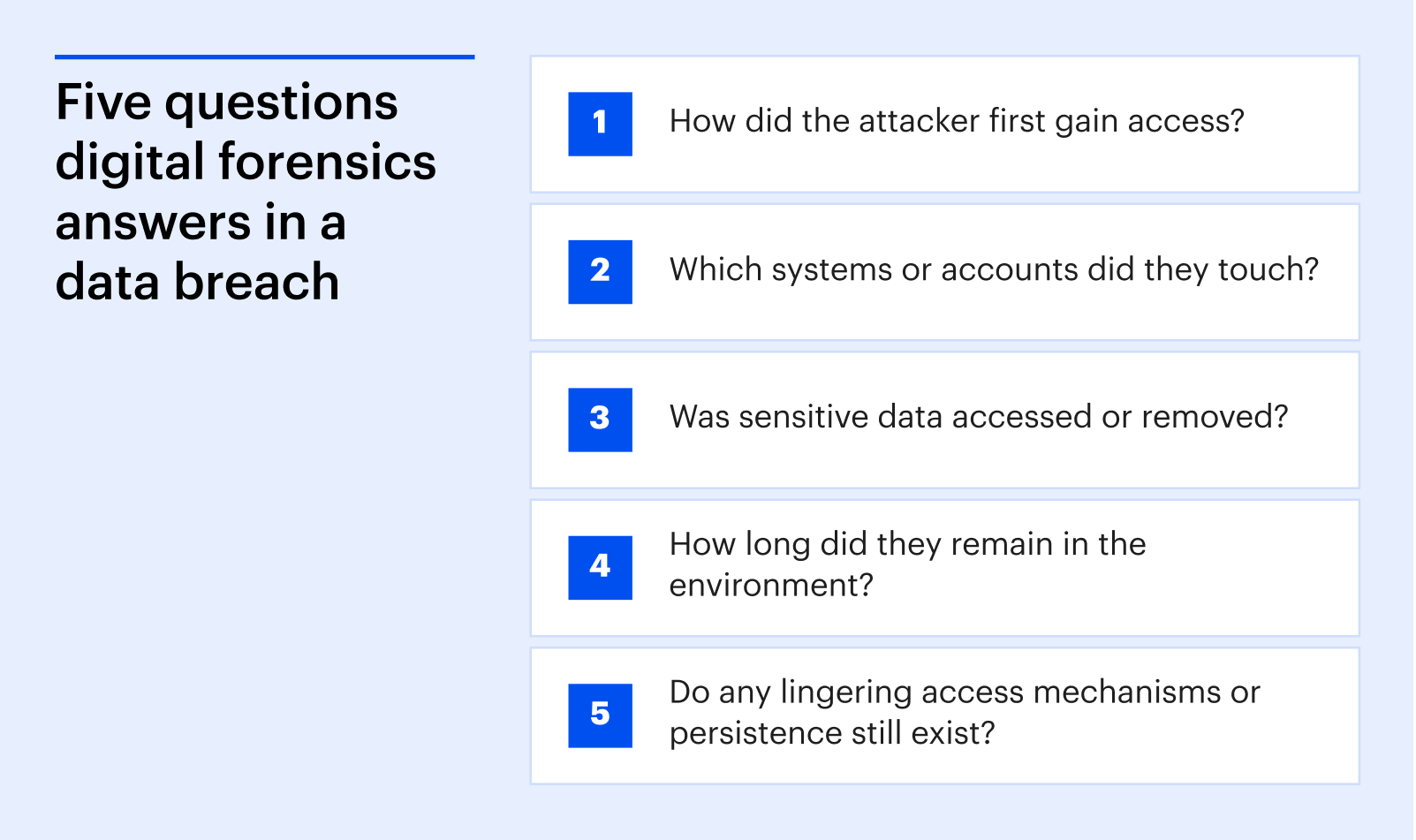
Together, the answers to those questions allow teams to move forward with confidence rather than uncertainty.
The value of that clarity becomes most apparent at the worst possible moment: when an attack has just been detected and the CISO is under immediate pressure to brief executive leadership. Security teams are expected to explain how the intrusion occurred, what systems and data were affected, and whether the threat is fully contained, all while decisions about containment, disclosure, and business continuity are being made in real time.
Without forensics, organizations find themselves unable to confidently or defensibly answer those questions. Digital forensics provides the factual grounding needed to move these conversations from uncertainty to clarity, even under intense time and stakeholder pressure.
The sections below follow the stages of data breach response, aligned with the NIST incident response framework, and show where forensic evidence changes the outcome at each one.
Phase 1: Initial response and containment guided by evidence
The first objective in a data breach is to stop the attacker’s access. But containment must be done carefully to avoid destroying volatile evidence.
Once initial triage has preserved volatile evidence, forensics informs safe containment by:
- Validating suspicious activity using logs and endpoint evidence
- Identifying compromised accounts
- Highlighting systems that should be isolated
- Identifying active sessions or open exfiltration channels
Phase 2: Evidence collection and building the forensic record
This is where digital forensics becomes the keystone of the investigation. It’s where security signals become preserved, examinable data that analysts can correlate across sources.
Using tools such as Magnet Axiom Cyber and Magnet Nexus, teams can collect:
- System and application logs
- Memory captures (running processes, live connections)
- File system artifacts
- Registry hives and persistence mechanisms
- Cloud data and authentication records
- Malware samples and web server artifacts
Evidence collected at this stage becomes the foundation for validating attacker behavior and supporting legal, regulatory, and insurance requirements.
Phase 3: Forensic analysis, identifying the breach path and the scope of impact
Analysis is where digital forensics transforms raw data into actionable insight.
Key forensic tasks include:
- Determining the initial vector (phishing, vulnerability, credential compromise, insider)
- Mapping attacker movement through endpoints, servers, and cloud services
- Detecting malware or web server exploitation evidence
- Correlating artifacts using logs, timestamps, network data, memory, and system metadata
- Identifying persistence mechanisms or backdoors
- Reconstructing timelines of access and exfiltration
Axiom Cyber’s integrated YARA, Sigma, and indicator of compromise (IOC) scanning accelerates these steps by highlighting suspicious processes, commands, or files immediately.
The most critical outcome: Determining what data was viewed or stolen.
This is the piece legal teams, regulators, executives, and customers depend on, and only digital forensics can provide a defensible answer.
Phase 4: Recovery and remediation, turning forensic findings into action
Rebuilding after a breach requires more than restoring systems.
Digital forensics can provide the intelligence needed to guide effective remediation. Information gathered from compromised endpoints can help teams identify:
- The initial point of compromise and the vulnerabilities, misconfigurations, or compromised credentials that need to be addressed.
- Attacker persistence mechanisms, such as backdoors, web shells, scheduled tasks, services, or unauthorized accounts that must be accounted for during remediation.
- Compromised credentials and accounts that should be reset, revoked, or otherwise secured across the environment.
- The extent of lateral movement to help determine which additional endpoints, servers, or accounts should be included in remediation efforts.
- The timeline of the compromise to help establish when attacker activity began and inform decisions about which backups or recovery points may be appropriate.
- Attacker behaviors and techniques that can be used to strengthen EDR detections, monitoring, access controls, and other security measures after the incident.
These forensic findings give remediation teams a clearer understanding of what needs to be addressed and why. Rather than analyzing systems after they have already been remediated, digital forensics provides intelligence from the compromised environment that can inform rebuilding, patching, credential resets, configuration changes, and enhanced monitoring designed to reduce the risk of the same attack path being used again.
Phase 5: Documentation and reporting, evidence-driven accountability
Regulatory frameworks such as HIPAA, GDPR, and NIS2 impose breach notification and reporting obligations, with the specifics depending on the organization, jurisdiction, and data involved. Forensics supplies the evidence needed to build this narrative with confidence.
Reports capture:
- Attack vectors and timelines
- Data exposed or exfiltrated
- Forensic methodology (critical for legal defensibility)
- Affected systems and accounts
- Remediation actions
- Recommendations for improving security posture
This forms the basis of executive briefings, legal decisions, customer communications, and updates to the organization’s incident response processes.
How Magnet Forensics tools support data breach investigations
Magnet Axiom Cyber
- Advanced artifact parsing
- Cloud, endpoint, and server collections
- Timeline reconstruction
- Integrated IOC, YARA, and Sigma rule scan engines
- Centralized analysis across diverse data sources
Magnet Nexus
- Scalable remote endpoint collections, on-demand or persistent deployment enterprise-wide
- Support for distributed endpoints
- Ideal for large-enterprise response efforts
Combined, these tools provide the visibility, depth, and precision required for accurate breach scoping and evidence-backed reporting.
To scale up your investigation with orchestration built for DFIR tooling and processes: Magnet Automate reduces manual handoffs by orchestrating repeatable collection, processing, and analysis workflows.
To share large datasets with legal, HR, leadership, or external stakeholders: Magnet Review helps analysts securely share relevant evidence and findings with stakeholders in one click, viewable right from their browser.
Forensics is the backbone of every data breach investigation
A data breach is an investigation as much as an incident. Digital forensics provides the truth organizations need to:
- Understand how attackers entered
- Determine what systems were affected
- Identify what data was exposed or stolen
- Remove backdoors and persistence
- Restore operations securely
- Meet regulatory obligations
- Strengthen defenses against future threats
When forensics guides the DFIR lifecycle, organizations respond quickly, correctly and with evidence to support their decisions.