

A consistent DFIR approach to ransomware, BEC, data breaches, and threat hunting
Key takeaways
- The DFIR lifecycle stays the same from one investigation to the next, but ransomware, BEC, data breaches, and threat hunting each rely on forensics to answer different questions.
- Containing an incident before collecting evidence can cost investigators critical context, like memory that may hold encryption keys or the mailbox activity and forwarding rules that show what a BEC attacker accessed.
- Forensic collection preserves volatile and disk artifacts that EDR tools may miss, only partially sample, or overwrite during response.
- Defining roles across teams, testing collection workflows ahead of time, and grounding post-incident reviews in evidence help teams build forensics into how they respond to incidents.
Cybersecurity incidents are no longer rare events. Today, they are routine, aggressive, and increasingly sophisticated. Organizations face ransomware that encrypts and exfiltrates data, business email compromise (BEC) scams that impersonate executives, stealthy data breaches that unfold over weeks, and hidden attacker activity that only proactive threat hunting can uncover.
Modern incident response requires more than quick containment. It requires digital forensics woven directly into the DFIR (digital forensics and incident response) lifecycle as a foundational capability that strengthens every phase of response.
In this article, we look at how digital forensics supports investigation and response across four common investigation scenarios: ransomware, business email compromise (BEC), data breach response, and threat hunting. Each comes with its own investigative questions, but all of them rely on the same forensic-driven principles.
Understanding the DFIR lifecycle and where forensics fits
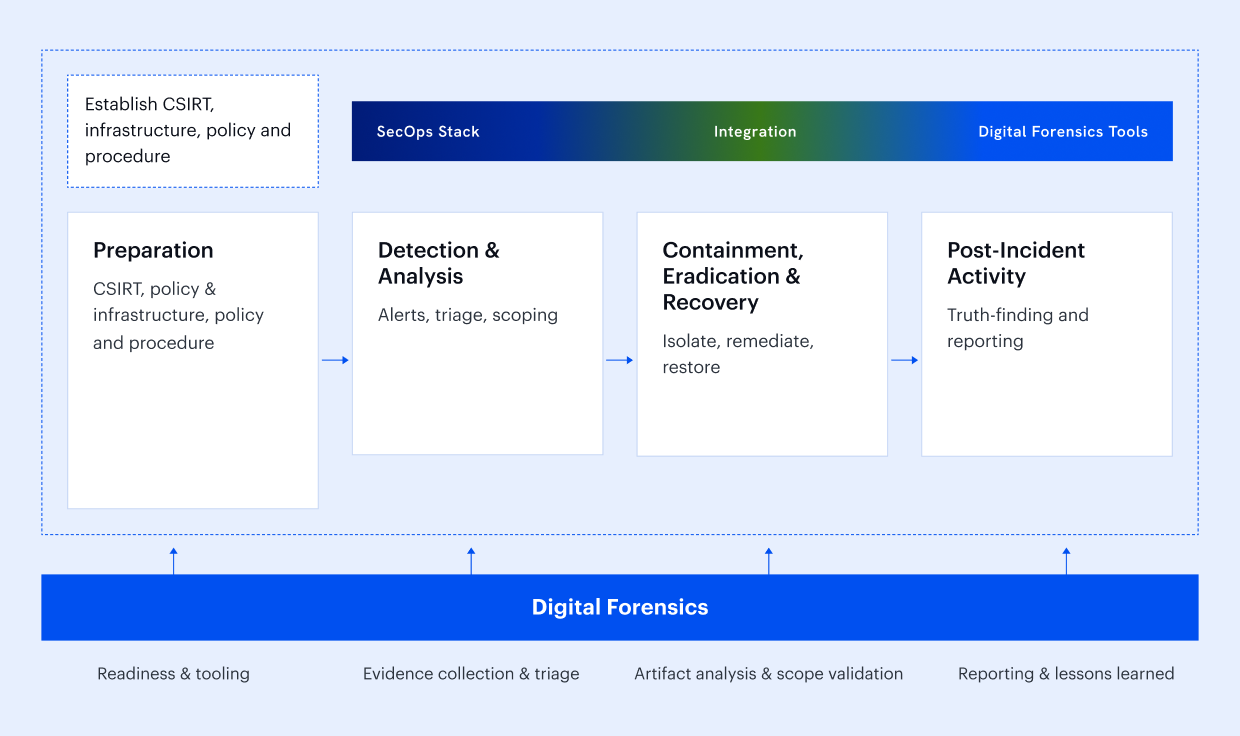
Most IR teams use variations of NIST SP 800-61 or MITRE ATT&CK. Regardless of the model, the DFIR lifecycle includes four key stages:
- Preparation
- Detection and analysis
- Containment, eradication and recovery
- Post-incident activity
Digital forensics plays a role in each of these stages, from the groundwork laid before an incident to the lessons learned after it.
1.Preparation: Building a forensic-ready foundation
Forensics begins long before an incident occurs. Organizations must ensure logging, remote acquisition capabilities, data storage processes, and forensic tools are in place ahead of time. Teams that test their collection workflows before an incident can act quickly and confidently when one happens.
2.Detection and analysis: Turning alerts into evidence
Alerts and security telemetry often provide the first indication of suspicious activity, but DFIR builds on those signals by validating them through evidence.
Forensic analysis helps:
- Identify malware variants (ransomware)
- Confirm credential theft or account misuse (BEC)
- Validate indicators of data exfiltration (data breach)
- Investigate anomalies and hidden attacker activity (threat hunting)
Forensics transforms siloed indicators into a complete, defensible narrative. This enables investigators to determine root cause, accurately scope the full extent of the incident, and understand how the intrusion unfolded across systems.
Many IR teams are well equipped to detect and contain threats but still struggle to answer how an attacker got in and what they did. Our eBook, Closing the investigative gap in incident response, explores why detection tools alone leave those questions open.
3.Containment, eradication and recovery: Evidence-guided decisions
Containment must be tactical and informed by deep dive analysis, not rushed.
Forensic evidence reveals:
- Persistence mechanisms
- Lateral movement patterns
- Data that attackers touched, altered, or exfiltrated
Ransomware and BEC workflows both highlight the risk of premature containment. Acting before the forensic picture is complete can destroy volatile evidence, overwrite memory artifacts, or tip off an attacker who still maintains access through a secondary foothold.
In ransomware cases, rushing to isolate systems without first capturing memory may eliminate the only opportunity to recover encryption keys or identify the initial staging server. In BEC investigations, disabling a compromised account before documenting its full mailbox activity and forwarding rules can collapse the evidentiary chain needed to understand what the attacker accessed and for how long. Evidence-guided containment is about being deliberate, so the actions taken to stop the bleeding don’t simultaneously obscure the wound.
4.Post-incident activity: Learning through forensic insight
Root cause analysis, compliance reporting, and long-term resilience require defensible evidence.
Digital forensics supplies:
- Timeline reconstruction
- Artifact interpretation
- Clear documentation for regulators and leadership
- Evidence to inform lessons learned and environment updates
How digital forensics strengthens response across four common investigation scenarios
The DFIR lifecycle stays consistent from one incident to the next, but the questions investigators need to answer change depending on the type of attack.
Here’s how forensics supports four of the most common scenarios.
Ransomware investigations: Combining rapid response with forensic depth

Ransomware requires immediate containment to stop data encryption, but containment must not destroy evidence needed to understand the attack.
Forensics enables:
- Identification of ransomware variants
- Recovery of volatile artifacts such as decryption keys
- Mapping of attacker lateral movement
- Determining whether data exfiltration occurred
Because affected systems are often isolated early in the response, investigators need a way to collect evidence without reconnecting them. Magnet Axiom Cyber and Magnet Response support offline forensic acquisitions from isolated hosts, preserving evidence essential for complete investigation.
Business email compromise (BEC): Forensics for account-level intrusions

BEC attacks often rely on legitimate credentials and ordinary looking email activity, so they can leave few obvious traces. That makes digital forensics indispensable.
Forensic workflows help:
- Determine how attackers accessed mailboxes
- Analyze forwarding rules, login anomalies, and headers
- Rebuild the timeline of unauthorized access
- Recover deleted messages
- Identify compromised credentials or tokens
These findings are critical for legal review, insurance requirements, and financial recovery.
Data breach response: Using evidence to identify what was stolen

Data breaches are often discovered after attackers have been active for weeks or months, which means investigators have to reconstruct what happened after the fact.
Forensic methods help:
- Validate unauthorized access
- Trace attacker movement
- Identify exfiltration channels
- Determine what data was viewed or stolen
This information drives regulatory notifications, legal response, and remediation strategies.
Threat hunting: Using forensics to detect what security tools miss
Threat hunting is inherently proactive, and forensics provides the artifacts needed to look deeper than automated tools:
- Memory captures that reveal hidden processes
- Registry artifacts showing persistence
- Network logs showing lateral movement
- Endpoint artifacts revealing attacker activity
Forensic analysis closes the loop on threat hunting, validating what the hypothesis suspected, disproving what the data doesn’t support, and surfacing attacker behavior that no alert ever fired on.
Shared DFIR challenges across all incident types
Across all four workflows, common challenges include:
- Rapidly evolving attacker techniques
- Large, complex datasets
- Strict chain-of-custody requirements
- Compliance and regulatory constraints
- Expertise and resource shortages
These pressures are a big part of why digital forensics needs to be built into incident response from the start instead of added later.
Why incident response is better with digital forensics
During an investigation, those pressures tend to surface as the same practical gaps
- Insufficient visibility into attacker actions
- Delayed detection due to subtle compromise techniques
- Limited ability to scope which systems or data were affected
- Lack of complete timelines after systems have been encrypted, wiped, or altered
Digital forensics addresses these gaps directly.
What forensics adds to DFIR
In practice, forensic analysis:
- Recovers deleted or hidden data
- Reconstructs attacker timelines
- Identifies initial access vectors
- Confirms whether data exfiltration occurred
- Maps behaviors to MITRE ATT&CK
- Generates legally defensible evidence
Without forensics, response efforts rely on assumptions. With forensics, they rely on facts.
Best practices for a forensic-integrated incident response approach
Integrating digital forensics into incident response takes more than the right tools. These five best practices can help teams build it into how they work.
1.Establish clear roles across teams
IR, IT, security, compliance, and legal must understand their responsibilities from the outset. Document these responsibilities so there’s no confusion when an incident arises.
2.Use specialized forensic tools
Solutions such as Magnet Axiom Cyber, Magnet Nexus, and Magnet Response enable:
- Targeted or full disk collections
- Remote endpoint acquisition
- Cloud and endpoint forensic capture
- Timeline and artifact analysis
3.Preserve evidence before containment
Volatile data, such as live memory, running processes, in-memory malware, active network connections, user sessions, decrypted credentials, command history, and short-lived artifacts, can be lost if containment occurs too quickly.
Digital forensic collection preserves this ephemeral evidence and complementary disk artifacts that EDR tools may not collect, may sample only partially, or may overwrite during response actions, ensuring critical context is retained for root cause analysis and full incident scoping.
4.Maintain continuous forensic readiness
Logging, backups, audit trails, and collection workflows must be in place before incidents arise.
5.Conduct post-incident reviews grounded in evidence
Forensics explains not only what happened but also why and how to prevent recurrence.
How Magnet Forensics enhances digital forensics in the DFIR lifecycle
Putting these practices in place is easier with purpose-built tools for forensic-driven response.
Here’s how Magnet Forensics’ enterprise digital forensics solutions support investigators at every stage of the DFIR lifecycle with:
- Remote, distributed evidence collection (Magnet Nexus)
- Offline or isolated system acquisition (Magnet Response)
- Deep forensic analysis across endpoints, cloud platforms, mobile, and logs (Magnet Axiom Cyber)
- Integrated IOC detection and timeline reconstruction
This combination accelerates detection, strengthens evidence quality, and supports defensible reporting for enterprises, law enforcement, and government agencies.
Key differentiators and strengths
- Specialized for post-incident investigation: Magnet is purpose-built for artifact-level review, forensic triage, legal and regulatory investigation, and centralized DFIR. This enables comprehensive root cause analysis and supports eDiscovery and legal evidence collection.
- Multi-source evidence correlation: Investigators can combine evidence from computer, cloud, IoT, mobile, and third-party sources into a single case for a holistic view of incidents.
- Legal defensibility and chain of custody: Magnet’s workflows are designed for legal and regulatory investigations, maintaining audit trails and defensible evidence management.
- Artifact-level review and advanced parsing: Enables advanced parsing, carving (including deleted data), timeline analysis, and data source consolidation for deep dive analysis.
- No file size limitations: Magnet preserves data integrity and reduces the need to break up evidence into chunks, unlike other solutions.
- Memory and volatile data acquisition: Magnet makes it easy to collect memory and volatile artifacts, which are critical for incident response.
- Reliable remote collection and automation: Magnet Axiom Cyber and Magnet Nexus support remote collection of computer data, including memory and volatile data, and automate workflows to reduce manual effort and speed up investigations.
- Comprehensive evidence management: Magnet’s solutions facilitate correlation of evidence from multiple sources and tools, supporting post-incident investigations and regulatory requirements.
- Integration and extensibility: Magnet Automate API enables workflow automation and integration with third-party data sources, enhancing investigative capabilities.
- Built for internal DFIR teams: Magnet solutions are designed for investigations where thoroughness, collaboration, and legal defensibility matter most.
Building a consistent, forensic-driven approach to incident response
Ransomware, BEC, data breaches, and threat hunting each put different pressure on an incident response team. Ransomware forces fast containment decisions, BEC hides inside legitimate accounts, data breaches have to be reconstructed after the fact, and threat hunts start with a hypothesis instead of an alert. What they all share is the need for evidence that shows how an attacker got in, what they did, and what was affected.
Building digital forensics into every stage of the DFIR lifecycle gives teams a consistent way to answer those questions, whatever the incident. It helps them contain threats without losing critical evidence, scope incidents accurately, and give legal, compliance, and leadership teams findings they can stand behind.
To help make the case for DFIR investment with your leadership team, download Uncover the value of DFIR: How digital forensics delivers an unbeatable ROI and enhances resilience.