

Digital fraud in a connected world: how it works and how to prevent it
By Steve Gemperle
Key takeaways
- Digital fraud losses topped $16 billion (FBI) and $12.5 billion (FTC) in 2024 and both agencies say reported numbers likely understate the real scale.
- Fraud succeeds by manufacturing urgency and isolation, pushing victims to act before they can verify or consult anyone else.
- AI is lowering the barrier to convincing digital fraud, from polished phishing messages to deepfake voices and synthetic documents.
- Verifying through a separate channel stops most digital fraud before it starts. Call the bank, employer, or vendor using a number you already have, not one from the message itself.
Digital fraud is no longer a niche cybercrime problem carried out only by highly technical actors. It has become a daily risk woven into ordinary life: a text message that looks like it came from a bank, a fake online storefront, a fraudulent job posting, a compromised email account, or an investment opportunity that seems too good to be true.
The FBI’s Internet Crime Complaint Center reported that it received 859,532 complaints of suspected internet crime in 2024, with reported losses exceeding $16 billion, a 33% increase in losses from the prior year.
The Federal Trade Commission similarly reported 6.5 million consumer reports in 2024, including 2.6 million fraud reports and 1.1 million identity theft reports, with consumer fraud losses above $12.5 billion. Those figures only capture reported incidents, which means the real scale of digital fraud is almost certainly larger.
At its core, digital fraud is about deception. Criminals use technology to create urgency, impersonate trusted people or institutions, and move money or data before the victim has time to slow down and verify what’s happening.
The tools have changed, but the human targets remain the same: trust, fear, curiosity, greed, loneliness, and convenience.
This article explains the main forms of digital fraud, why the threat is expanding, how it impacts victims and organizations, and the practical steps you can take to reduce risk.
What digital fraud looks like
Digital fraud covers a broad family of schemes that use computers, mobile devices, online accounts, payment systems, and social platforms to steal money, data, or access. Some fraud begins with malware or a stolen password, but most of it begins with social engineering: a carefully crafted message designed to make a person act before thinking.
The fraudster’s goal is often simple: get the victim to click, pay, disclose credentials, approve a login, or transfer funds. The following are some of the most common types of digital fraud:
- Phishing, smishing, and vishing: Fraudsters send deceptive emails, text messages, or phone calls that appear to come from legitimate organizations. These messages commonly claim that an account is locked, a package cannot be delivered, a payment failed, a toll payment is owed, or suspicious activity has been detected.
- Account takeover: Criminals gain access to a victim’s email, banking, payroll, social media, or shopping account, often by stealing passwords or tricking the victim into sharing a one-time code. The FBI warned in 2025 that account takeover schemes involving impersonation of financial institution support had generated more than 5,100 complaints and over $262 million in losses since January of that year.
- Business email compromise: A fraudster impersonates an executive, vendor, attorney, or trusted business contact to redirect payments, alter invoices, or initiate wire transfers. These schemes can be devastating because they exploit normal business workflows.
- Identity theft and synthetic identity fraud: Criminals misuse real personal information or combine real and fabricated details to open accounts, obtain credit, or pass identity checks.
- Investment and cryptocurrency scams: Victims are persuaded to move money into fake trading platforms, fraudulent crypto wallets, or “guaranteed” investment opportunities. The FTC reported investment scams as the largest fraud loss category in 2024, with losses of $5.7 billion.
- Online marketplace and shopping fraud: Fraudsters sell nonexistent products, counterfeit goods, or services that are never delivered. These schemes often rely on fake reviews, temporary websites, and payment methods that are hard to reverse.
- Romance, job, and imposter scams: Criminals build trust over time or impersonate government agencies, technical support, recruiters, law enforcement, or family members in distress. The emotional pressure can be as important as the technical setup.
- Sextortion/digital blackmail: Fraudsters will contact a victim via text or email stating that “pornography” or “child pornography” was found on the victim’s device. The criminal will threaten to use the victims contact list to send the “illegal images” to friends, family or co-workers unless paid.
Why digital fraud is growing
Digital fraud is growing because the digital economy gives criminals more opportunities, more speed, and more believable disguises. People bank, shop, date, apply for jobs, manage health information, and conduct business online. In addition, every new platform creates convenience for legitimate users and a potential opening for abuse.
- Data is widely available. Breached credentials, exposed personal information, public social media posts, and data broker records help criminals personalize scams and bypass weak security checks.
- Payments move quickly. Real-time payments, bank transfers, peer-to-peer apps, and cryptocurrency can reduce the time available to detect, stop, or reverse fraudulent transactions.
- Social engineering has become more professional. Fraud messages often use polished branding, realistic language, and timely context. A fake message about a delayed package or suspicious bank transaction can feel plausible because it resembles a real customer service interaction.
- Artificial intelligence changes the scale and believability of fraud. Generative AI tools can help criminals write better phishing messages, translate scams into multiple languages, create fake images or documents, and mimic voices or identities. AI does not create the intent to commit fraud, but it can lower the effort required to make a scam look credible.
- Work and personal life overlap online. A compromised personal email account may expose business documents, while a compromised work account may be used to target customers, vendors, or colleagues.
- Authentication exhaustion. Mobile device users have also become very accustomed to clicking on the “allow” button when it pops up because of the repetitive nature for app authentication. Criminals often rely on this exhaustion to bypass two-factor authentication (2FA).
The human and organizational impact of digital fraud
The financial losses from digital fraud are not always easy to measure. Often they don’t tell the whole story. Victims often experience embarrassment, anxiety, anger, and a loss of confidence in technology or institutions.
Older adults can be particularly affected when a scam drains retirement savings or creates fear of using online banking. Small businesses may face payroll disruption, damaged vendor relationships, legal exposure, and reputational harm after a single fraudulent transfer or compromised account.
For organizations, digital fraud is not only a cybersecurity issue. It’s also an operational, legal, financial, and trust issue. A fraud event can expose weaknesses in vendor management, employee training, payment approval processes, customer support scripts, identity verification, and incident response. A company may have excellent technical controls but still lose money when one employee is pressured into bypassing a process. Conversely, a well-trained team with strong procedures can often detect a suspicious request before it becomes a loss.
How fraudsters manipulate trust
Most digital fraud succeeds because the criminal controls the moment. The victim is pushed into a narrow decision window: click now, verify now, send money now, approve the code now.
The scam often includes a reason the victim should not consult anyone else. That isolation is intentional. Fraudsters know that a pause, a second opinion, or an independent phone call to a known number can break the spell.
Anatomy of a fraud message
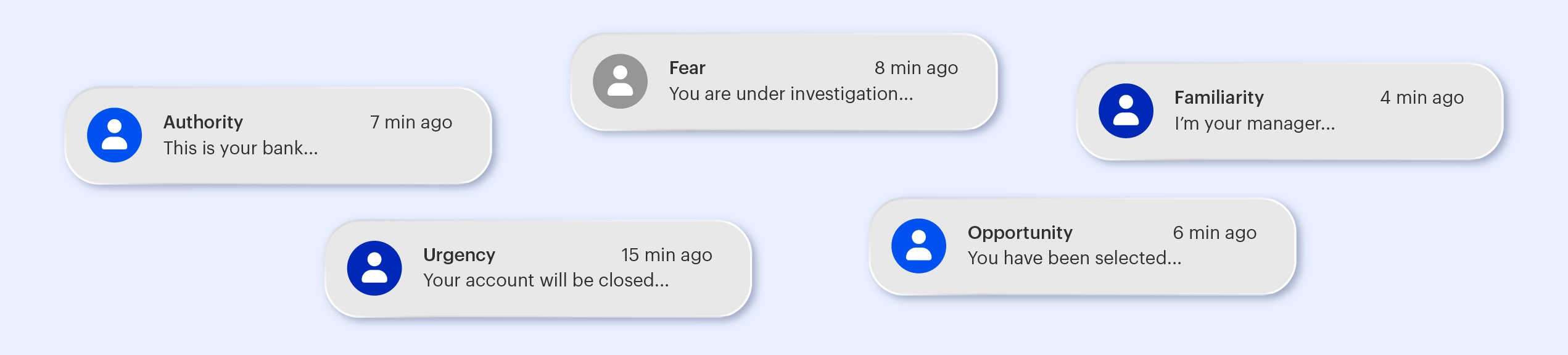
These pressure tactics tend to show up in familiar phrases, such as:
- Authority: “This is your bank,” “This is law enforcement,” or “This is your IT department.”
- Urgency: “Your account will be closed,” “Payment is overdue,” or “Someone is using your card.”
- Fear: “You are under investigation,” “Your computer is infected,” “Your benefits will be suspended,” or “You’ll be arrested / an arrest warrant has been issued.”
- Opportunity: “You have been selected,” “This investment is guaranteed,” or “This job pays immediately.”
- Familiarity: “I’m your manager,” “I’m your vendor,” or “I’m a family member who needs help.”
Practical digital fraud prevention for individuals
Consumers cannot eliminate digital fraud entirely, but they can make themselves harder targets. The most effective habits are simple, repeatable, and built around verification rather than reaction.
- Slow down when a message creates panic. Urgency is a warning sign. Take a minute to verify through a separate channel.
- Use strong, unique passwords and a password manager. Reused passwords turn one breach into many compromised accounts.
- Turn on multi-factor authentication. App-based authentication or hardware security keys are stronger than text message codes when available.
- Never share one-time passwords (OTP). A legitimate bank, government agency, or support representative should not need a one-time code to “protect” an account.
- Verify requests independently. If a bank, employer, vendor, or family member asks for money or sensitive information, contact them using a number, website, or address you already trust.
- Be skeptical of payment methods that are difficult to reverse. Wire transfers, cryptocurrency, gift cards, and some peer-to-peer payments are frequently used because recovery can be difficult.
- Government will never ask for payment through gift cards. Government officials will not accept prepaid gift cards for any fine/ticket/toll charge — ever.
- Monitor accounts and credit reports. Early detection matters. Alerts for new logins, password changes, large transactions, and new credit activity can reduce damage.
- Report fraud quickly. Contact the financial institution, preserve messages and transaction details, and report suspected internet crime to the FBI’s IC3 and consumer fraud to the FTC.
Practical digital fraud prevention for organizations
Organizations need layered controls because no single tool can stop every fraud attempt. The goal is to make fraud harder to initiate, easier to detect, and faster to contain. Effective programs combine technology, process discipline, training, and leadership support.
- Strengthen identity and access management. Require multi-factor authentication, limit privileged access, review access regularly, and disable accounts promptly when roles change.
- Use payment verification controls. Require callback verification for new vendors, bank account changes, urgent transfers, and unusually large payments. The callback should use a known, previously verified number, not contact information supplied in the request.
- Separate duties for high-risk transactions. No single employee should be able to create, approve, and release sensitive payments without review.
- Train employees with realistic scenarios. Training should include phishing, business email compromise, vendor impersonation, deepfake voice risks, QR code scams, and pressure tactics.
- Monitor behavior and transactions. Fraud detection improves when systems can identify unusual logins, impossible travel, new devices, suspicious payment destinations, and deviations from normal activity.
- Protect email and collaboration platforms. Use domain authentication, anti-phishing protections, safe link scanning, and alerting for suspicious forwarding rules or mailbox access.
- Prepare an incident response playbook. A fraud playbook should identify who contacts the bank, who preserves evidence, who communicates internally, who handles customer notifications, and when law enforcement should be contacted.
- Encourage a no-blame reporting culture. Employees should feel comfortable reporting a suspicious click, mistaken disclosure, or questionable request immediately. Shame and delay help the fraudster.
Investigating digital fraud
When digital fraud occurs, speed and evidence preservation matter. The first priority is to stop additional loss: contact financial institutions, freeze or close compromised accounts, reset credentials from a clean device, revoke suspicious sessions, and preserve relevant records.
The second priority is to create a clear timeline. Investigators need to understand when the first contact occurred, what the victim clicked or shared, what accounts were accessed, what money moved, and what communications were received:
- Original emails, including header information when available.
- Text messages, call logs, voicemails, chat messages, and social media profiles used by the fraudster.
- Payment records, wallet addresses, transaction IDs, bank transfer confirmations, invoices, and receipts.
- Login alerts, IP-related security notifications, password reset emails, and account activity logs.
- Screenshots of fraudulent websites, postings, profiles, or advertisements, along with the date and time they were captured.
- Internal approvals, purchase orders, vendor change requests, or communications related to the fraudulent transaction.
Reporting is critical. Reports help banks attempt recovery, help law enforcement identify patterns, and help regulators warn the public.
Details matter. If you ever become impacted by digital fraud, help law enforcement by providing as much detail as you can regarding the event. Contact law enforcement as soon as the fraud is detected, provide a description of the events and gather all relevant documentation. Timely reporting can connect one victim’s experience to a larger campaign targeting other people or organizations.
The future of digital fraud
The next stage of digital fraud will be faster, more personalized, and more difficult to recognize at a glance. Artificial intelligence can help defenders identify patterns, summarize alerts, and detect anomalies, but criminals also use AI to make scams more convincing. Deepfake audio, synthetic documents, fake customer service sites, and automated phishing campaigns will put more pressure on traditional verification methods.
The best response is not panic; it’s resilience. Individuals and organizations should assume that convincing fraudulent messages will arrive and design routines that withstand pressure. In practice, that means trusted verification channels, clear approval rules, strong authentication, continuous monitoring, and a culture that rewards caution. Fraud prevention is not about distrusting every message. It’s about knowing which moments require a pause.
Staying ahead of digital fraud
Digital fraud succeeds when technology amplifies old fashioned deception. The fraudster’s tools may include stolen credentials, fake websites, social media profiles, cryptocurrency wallets, or AI-generated messages, but the central tactic is usually the same: make the target act quickly and alone.
Reducing digital fraud requires more than better software. It requires informed people, disciplined processes, reliable reporting, and systems designed to make verification easy. As digital life continues to expand, fraud will remain a persistent threat, but it’s not an unstoppable one. The most effective defense begins with a simple habit: pause, verify, then act.
References
- Federal Bureau of Investigation, Internet Crime Complaint Center: 2024 Internet Crime Report and related 2024 annual report release. https://www.fbi.gov/news/press-releases/fbi-releases-annual-internet-crime-report
- Federal Trade Commission: Consumer Sentinel Network Data Book 2024. https://www.ftc.gov/reports/consumer-sentinel-network-data-book-2024
- Federal Bureau of Investigation: Public Service Announcement on account takeover fraud via impersonation of financial institution support. https://www.fbi.gov/investigate/cyber/alerts/2025/account-takeover-fraud-via-impersonation-of-financial-institution-support
- US Secret Service, Financial Investigations https://www.secretservice.gov/investigations/financial
About the author
Steve Gemperle is the Manger of Technical Marketing and Forensics at Magnet Forensics. Prior to joining Magnet, Steve was a Senior Special Agent with the United States Secret Service who specialized in cyber-crime until retiring in 2021. For the last decade of his career with the Secret Service he focused on computer crimes and served as Lab Director for the US Secret Service Southwest Regional Computer Forensic Lab. Steve has completed over 1900 forensic exams and 150 network intrusion investigations while working for the Secret Service, and has been recognized as one of the US Secret Service’s top network intrusion investigators.