
Where digital investigations stall: 5 findings from 300+ public sector professionals
Key takeaways
- Magnet Forensics surveyed 306 public sector professionals who work closely with digital evidence for our inaugural Clearing the path to justice: 2027 public sector digital investigations report.
- The findings point to three barriers between evidence and answers. Eighty-one percent have been unable to access evidence they believed existed, and 69% say sharing or handoff issues slow case progress. And while 56% have encountered manipulated, synthetic, or AI-generated media, only 17% are confident their agency can identify it.
- The path forward is a more connected investigation, with 84% saying stronger integration across tools, teams, and workflow stages would improve investigative outcomes.
Every piece of digital evidence is part of someone’s story. A text message that backs up a victim’s account. A location record that clears someone who was never there. A video that shows what actually happened. The professionals who uncover those details and stand behind them in court are doing some of the most critical work in public safety, and they’re expected to get it right every time.
That work is getting harder. For our first public sector digital investigations report, Magnet Forensics surveyed 306 public sector professionals who work closely with digital evidence, including digital forensic examiners, investigators, lab managers, and legal professionals, to understand where investigations are slowing down. Their answers point to three key barriers: accessing evidence, sharing it with the people who need it, and proving it is what it appears to be.
Here’s where those barriers show up and what professionals say would help.
1. Four in five professionals couldn’t access evidence they believed existed
In the past 12 months, 81% of respondents encountered issues accessing digital evidence they believed existed, and 68% say acquiring relevant evidence takes more time than it did just two years ago. Device encryption and passwords are the most commonly cited obstacle (65%).
Confidence drops with newer evidence sources. More than eight in 10 respondents who work with mobile device data are very or extremely confident their organization can access it. For vehicle, drone, and IoT data, fewer than half say the same. Only 51% agree they can keep pace with new devices, apps, operating systems, and data sources, and among digital forensic examiners, that drops to 45%.
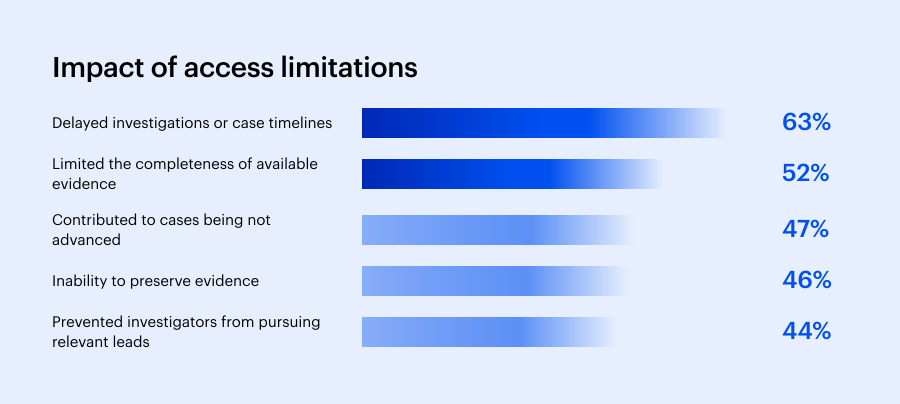
Sixty-three percent say access limitations have delayed investigations or case timelines, and 44% say they’ve kept investigators from pursuing relevant leads. Each gap leaves investigators working with an incomplete picture of what happened.
2. Sharing and handoff issues slow cases, especially for investigators
Sixty-nine percent of respondents say evidence sharing, handoff, or collaboration issues slow case progress. Among investigators, that rises to 79%. More than half of those facing these issues (55%) say the impact is severe or major, and respondents pointed to breakdowns at every handoff, from field investigators to examiners and back, and on to prosecutors, courts, and defense.
Part of the problem is how evidence gets shared. On average, respondents’ organizations use 3.7 different methods to share digital evidence, and 65% still use USB drives, hard drives, DVDs, or other physical media to do it. Only about a third (34%) share evidence through a cloud or SaaS evidence management system. The appetite for change is there: more than eight in 10 agree cloud or SaaS platforms could improve collaboration and the speed of evidence sharing. But governance is setting the pace, with 74% wanting clearer policies before expanding cloud use for digital evidence.
Every stalled handoff is time a case isn’t moving forward, for investigators, prosecutors, and the people whose lives the case affects.

3. Synthetic media is already in casework, and few agencies can identify it
Fifty-six percent of respondents have encountered manipulated, synthetic, or AI-generated media in their investigations, most often in internet crimes against children (ICAC) cases. Only 17% are confident their agency can identify it, and 16% say their organization has no formal method for verifying media at all.
The risk runs both ways. A convincing fake can send an investigation in the wrong direction, and genuine evidence can be dismissed if no one can prove it’s real. More than a third have already faced a claim that a piece of evidence isn’t real, and just a quarter are confident they can prove genuine media hasn’t been altered.

4. AI tools have interest, but not yet trust
Forty-one percent of respondents use AI in their investigations today. Among them, 73% expect AI-assisted capabilities to be very helpful or essential to future investigations, but only 27% say the current state of AI meets their needs. Among those who don’t use AI yet, 85% are open to using it to improve the efficiency of their investigations.
Accuracy and false positives top the list of AI concerns (64%), and nearly half cite difficulty supporting AI results in court or formal proceedings. Professionals expect AI-assisted tools to meet the same standard as the rest of their work.
5. Professionals agree on what needs to change
Respondents don’t see these as isolated problems. Eighty-four percent say stronger integration across tools, teams, and workflow stages would improve investigative outcomes. Across roles, the same core needs came through:

They also put people first: 46% rank training and upskilling staff among their organization’s top three priorities for the next one to two years, more than any other area.
Moving investigations forward
Every finding in the report comes back to one question: can investigators get to the evidence, get it to the people who need it, and stand behind it when it matters? For many agencies today, that’s getting harder to do.
Making it easier means connecting every stage of the investigation, from first access to final review, and investing in the people doing the work. When evidence can be reached quickly, shared without friction, and trusted in court, cases keep moving and the story that evidence tells can be heard in full. That’s what victims, communities, and the professionals who serve them are counting on.
The full report goes further, including what professionals say would most improve their access to digital evidence, what’s holding agencies back from cloud-based evidence workflows, and the connected investigative workflow agency leaders can build toward.
Download Clearing the path to justice: 2027 public sector digital investigations report or register for the webinar Overcoming barriers to digital evidence.