

Threat hunting with digital forensics
How forensic evidence helps validate hypotheses, uncover hidden attacker activity, scope risk, and strengthen detection
By Jeff Rutherford
Key takeaways
- Threat hunting starts with a question, not a confirmed incident. Is my network compromised? The goal is to use available evidence to determine whether suspicious behavior represents attacker activity, benign activity, or a gap that requires further investigation.
- Digital forensics gives threat hunters artifact-level evidence that can validate or disprove a hypothesis, reconstruct the sequence of activity, and reveal behavior that automated detections may not surface on their own.
- The strongest hunts correlate evidence across endpoints, authentication systems, networks, cloud services, memory, and malware indicators rather than relying on a single alert or indicator of compromise.
- A successful hunt should improve what happens next: scoping and containment when malicious activity is found, and stronger detection rules, monitoring, access controls, and future hunting hypotheses after the investigation is complete.
Threat hunting is a proactive search for attacker activity that may not have generated a clear alert. Instead of waiting for an incident to announce itself, hunters begin with a question based on threat intelligence, prior incidents, unusual behavior, or known adversary techniques and then test that question against evidence in the environment. Digital forensics strengthens that process by giving investigators access to the artifacts needed to confirm what happened, reconstruct activity over time, and determine whether an anomaly is isolated or part of something larger.
Core principle of threat hunting: hunt for evidence of behavior, not just known indicators
Indicators of compromise can be useful starting points, but a threat hunt becomes more valuable when it looks beyond a known hash, domain, or IP address and asks what the attacker would have done on the system. Registry changes, authentication activity, process execution, persistence mechanisms, network connections, cloud activity, and volatile memory can reveal behavior even when the exact indicator has never been seen before.
The objective is to determine whether the available evidence supports the hunting hypothesis, understand the activity in context, and identify the systems, accounts, or data that may require deeper investigation. That evidence-based approach helps distinguish suspicious activity from normal behavior and gives response teams a defensible basis for deciding what to do next.
What makes threat hunting different from traditional incident response?
Traditional incident response usually begins after a detection, user report, or other event indicates that something may already be wrong. Threat hunting begins earlier and with less certainty. A hunt may start with intelligence about a technique, a pattern observed in another incident, an unusual authentication event, or a hypothesis about how an attacker could persist or move through the environment.
That creates a different set of investigative questions:
- What behavior are we looking for, and why do we believe it may exist in the environment?
- Which data sources are most likely to contain evidence that would support or disprove that hypothesis?
- Does the activity represent normal user or system behavior, a misconfiguration, or malicious activity?
- If malicious activity is confirmed, when did it begin and what systems, accounts, or cloud resources were affected?
- Are there signs of persistence, credential misuse, lateral movement, or related attacker actions elsewhere in the environment?
- What should change in monitoring, detection, access controls, or future hunts as a result of what was found?
Threat hunting begins with a question worth testing
A useful hunt starts with a focused question. A narrowly defined question helps investigators identify which evidence matters and keeps the hunt from becoming an open-ended review of everything in the environment.
The question can be behavior-focused. For example, a team may want to determine whether valid credentials are being used from unexpected locations or devices, whether a persistence mechanism is present on endpoints that have not generated alerts, or whether activity associated with lateral movement appears across multiple systems.
The question can also change. The first evidence reviewed may disprove the original theory, reveal a benign explanation, or surface a different pattern that warrants a new question. That is a useful outcome. Threat hunting is not about proving the hunter was right; it’s about following the evidence far enough to understand what the activity represents.
The evidence that gives a threat hunt context
The most useful evidence depends on the hypothesis being tested, but threat hunting often requires correlation across several sources. The value comes from connecting artifacts that may look insignificant on their own and using them to establish sequence, attribution, persistence, or scope.
| Evidence category | Examples | Investigative value |
|---|---|---|
| Endpoint and execution artifacts | System and application logs, registry entries, process and execution artifacts, persistence mechanisms | Can reveal execution, configuration changes, persistence, abnormal user or attacker activity, and other endpoint behavior that may not have generated a dedicated alert. |
| Authentication and account activity | Successful and failed logins, account activity, unusual access attempts, credential-related events | Helps identify credential theft or misuse, unauthorized access, anomalous sign-in behavior, and activity that may connect multiple systems or services. |
| Network evidence | Network activity logs, traffic captures, connection history | Can expose unexpected communications, command-and-control activity, lateral movement, and relationships between endpoints that warrant deeper investigation. |
| Cloud evidence | Cloud collections, application activity, account and service records | Extends the hunt beyond the endpoint and can reveal related activity in cloud services or distributed environments. |
| Memory and volatile data | Memory captures, running processes, active connections, short-lived artifacts | May reveal hidden processes, in-memory activity, credentials, or transient attacker behavior that is not preserved on disk. |
| Malware and detection indicators | Malware indicators, IOCs, YARA matches, Sigma detections | Provides technical leads that can be correlated with broader forensic artifacts and used to identify related activity across the environment. |
How a forensic threat hunt develops
A hunt rarely moves in a perfectly linear sequence. Investigators may move back and forth between collection and analysis as new findings change the question or reveal additional systems that need to be examined. Even so, several investigative activities tend to shape an effective forensic hunt.
Start with the evidence most likely to answer the question
Collection should be driven by the question being tested. Authentication logs may be the logical starting point for suspected credential misuse, while endpoint artifacts, registry data, and memory may be more useful when the hypothesis involves persistence or hidden malware. Network and cloud evidence may be needed when the hunt involves lateral movement or activity that crosses traditional endpoint boundaries.
Prioritizing relevant sources keeps the hunt focused while still allowing investigators to expand collection when the evidence points elsewhere. In distributed environments, remote collection can help bring endpoint evidence into the investigation without waiting for devices to be physically moved or touched by DFIR personnel.
Correlate artifacts instead of reviewing them in isolation
A single event may be ambiguous. A successful login, registry change, process execution, or network connection may each have a legitimate explanation. Correlation is what gives those artifacts meaning. When multiple sources show related activity at the same time, investigators can begin to determine whether the behavior represents normal operations or an attacker sequence.
Forensic analysis can combine endpoint artifacts, logs, registry evidence, network activity, cloud records, memory, IOCs, YARA matches, and Sigma detections to identify patterns that may not be visible in any one source. Mapping observed behavior to MITRE ATT&CK can also help communicate the tactics and techniques represented by the evidence.
Reconstruct the timeline
Timelines help turn a collection of artifacts into an investigative narrative. Ordering artifacts from logs, the registry, authentication activity, and network evidence by time can establish when suspicious behavior began, what happened next, and which actions may be connected.
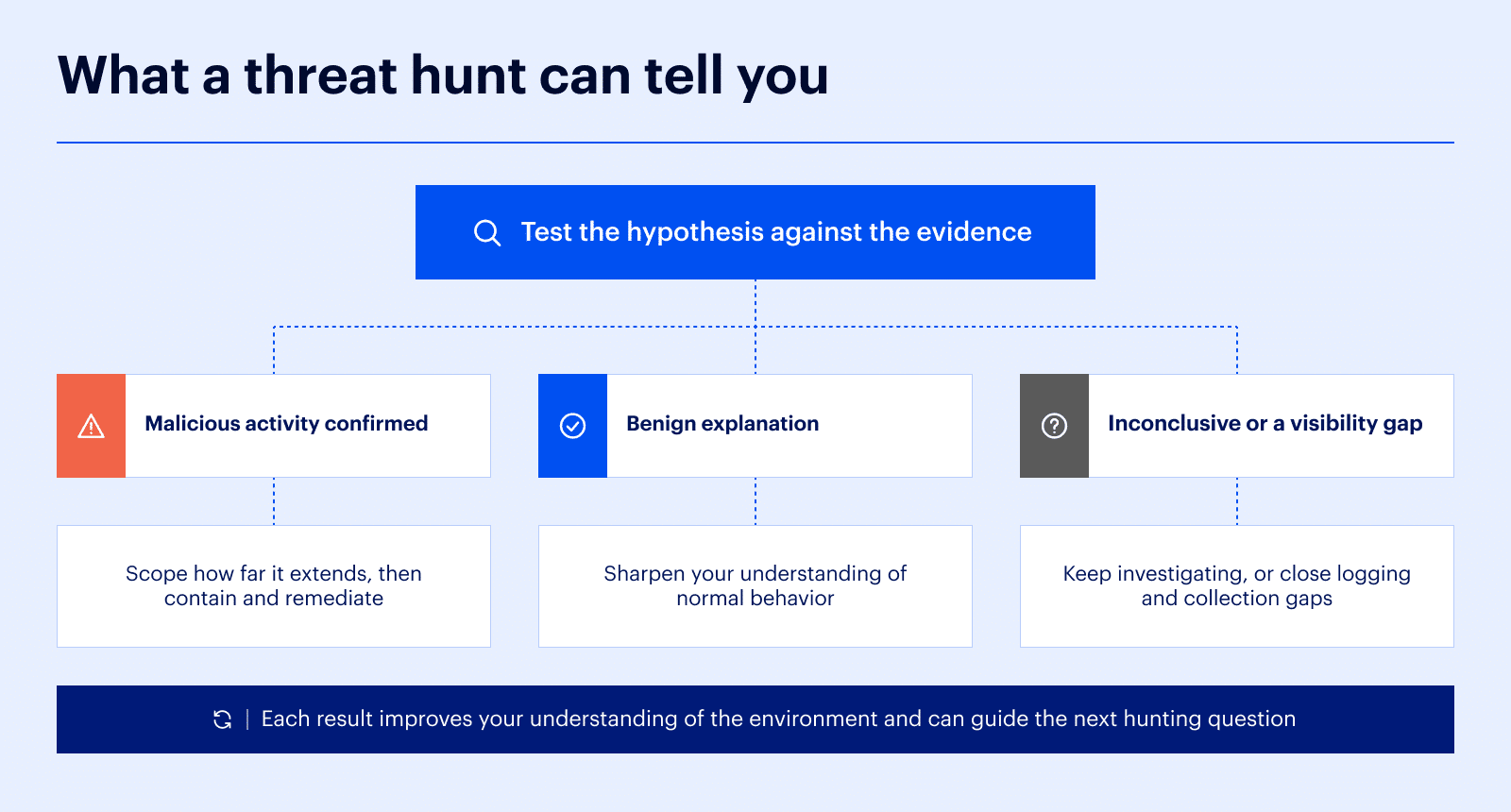
The timeline should be used to test the original question rather than force the evidence to fit it. A hunt may confirm malicious activity, show that the behavior was benign, or reveal that the original anomaly was only one part of a broader intrusion. Each result improves understanding of the environment and can guide the next investigative question.
Scope beyond the first suspicious system or account
When malicious activity is confirmed, the hunt changes from a search for possibility to an investigation of scope. Investigators should determine whether the same behavior, indicators, credentials, persistence mechanisms, or network relationships appear elsewhere. The objective is to understand how far the activity extends before containment and remediation decisions are considered complete.
Common threat hunting questions
Threat hunting can be applied to many forms of suspicious activity:
Credential theft and misuse
Authentication records, endpoint activity, and related artifacts can help determine whether valid credentials are being used in abnormal ways and whether account misuse is connected to other attacker activity.
Malware persistence
Registry entries, endpoint artifacts, memory, and execution evidence can reveal persistence mechanisms or hidden processes that may remain after the initial point of compromise is no longer obvious.
Network intrusion and lateral movement
Network activity, authentication events, endpoint artifacts, and timelines can help identify relationships between systems and show whether suspicious activity moved beyond the first host examined.
Insider activity
Forensic artifacts can help place unusual user actions in context and distinguish isolated behavior from a broader pattern that requires additional investigation.
Advanced persistent threat activity
Longer-running intrusions often require investigators to correlate subtle evidence across endpoints, accounts, cloud services, and network sources to identify activity that traditional detections may have missed.
From hunt finding to response decision
Once evidence supports malicious activity, the hunt’s forensic findings become the basis for response. They can help responders determine what to isolate, which accounts or credentials need to be disabled, and what additional systems require investigation. Accurate scoping reduces the risk of treating only the first visible symptom while related attacker activity remains elsewhere.
Findings can also guide mitigation after immediate containment. Evidence from the hunt may identify vulnerabilities to patch, access controls to strengthen, monitoring gaps to close, and behaviors that should become new detection logic. In that way, a hunt can improve both the current response and the organization’s ability to identify similar activity earlier in the future.
What digital forensics adds to threat hunting
Alerts and threat intelligence help hunters decide where to look. Digital forensics supplies the evidence needed to reach a conclusion, in four ways.
Validates what telemetry suggests
Security alerts and threat intelligence can point investigators in a direction, but forensic artifacts provide the underlying evidence needed to determine whether the activity actually occurred and how it unfolded.
Reconstructs attacker actions
Correlating artifacts across sources produces a timeline that explains sequence and context rather than presenting isolated events.
Can recover evidence that is easy to overlook
Hidden, deleted, obfuscated, or short-lived artifacts may provide the detail needed to identify persistence, understand attacker behavior, or connect activity across systems.
Improves future detection
The behaviors and artifacts identified during a hunt can be translated into stronger detection rules, monitoring, access controls, and future hypotheses, creating a feedback loop between investigation and prevention.
When a threat hunt finds nothing
A hunt that doesn’t confirm malicious activity can still be useful. Disproving a question helps analysts better understand normal behavior and may expose gaps in logging or collection that would make the same question difficult to answer during a real incident. Those lessons can be used to improve forensic readiness before the next hunt begins.
How Magnet Forensics supports threat hunting
Threat hunting often requires investigators to collect evidence from distributed endpoints and analyze large, diverse datasets without losing artifact-level detail. Magnet Nexus and Magnet Axiom Cyber offer complementary capabilities for that work.
- Magnet Nexus supports remote collection from Windows, macOS, and Linux endpoints so investigators can bring relevant evidence into a centralized threat hunting and forensic analysis workflow.
- Magnet Axiom Cyber supports detailed artifact parsing and visualization across collected evidence, including investigative workflows using indicators of compromise, YARA rules, and Sigma rules.
Used together, these capabilities can help investigators collect relevant evidence, correlate subtle indicators across systems, build timelines, and move from a hunting hypothesis to an evidence-based conclusion.
Preparing an environment for forensic threat hunting
Threat hunting is only as effective as the evidence available to answer the questions. Teams should establish the logging, collection capabilities, and investigative processes needed before a hunt begins so that important artifacts are available when a hypothesis needs to be tested.
- Maintain comprehensive logging and monitoring across endpoints, authentication systems, networks, and cloud services.
- Establish collection capabilities for endpoint, cloud, memory, and other forensic evidence likely to be needed during a hunt.
- Use threat intelligence, prior incidents, and known adversary behavior to develop focused hunting hypotheses.
- Define how findings will be documented, escalated, scoped, and handed into incident response when malicious activity is confirmed.
- Feed lessons from completed hunts back into detection rules, monitoring, access controls, and future threat hunting priorities.
Treat threat hunting as an evidence-led investigation
Threat hunting is most effective when it goes beyond searching for known indicators and uses forensic evidence to explain behavior. A hypothesis creates the starting point, but the artifacts determine where the investigation goes next. By correlating endpoint, authentication, network, cloud, memory, and malware evidence, investigators can validate suspicious activity, reconstruct attacker actions, and determine whether the behavior extends beyond the first anomaly.
Each hunt leaves the team with a better understanding of the environment, a clearer basis for containment when malicious activity is found, and stronger detections and investigative readiness for the next threat.
See how forensic evidence supports threat hunting in practice: watch Digital investigations for data-driven threat hunting or request a free trial of Magnet Axiom Cyber.
About the author

Jeff Rutherford, Forensic Consultant at Magnet Forensics, is a retired FBI Supervisory Special Agent with more than twenty years of experience in organized crime, crimes against children, counterterrorism and cybersecurity related investigations. Jeff achieved specialized certification as a Technically Trained Agent and an FBI Certified Digital Forensic Examiner and holds certifications from IACIS (CFCE) and SANS (GCFA). While assigned to the North Texas Regional Computer Forensic Laboratory, Jeff conducted digital forensic examinations for various agencies (state, local, and federal) across North Texas. Jeff also led the FBI Dallas Technical Operations Squad responsible for the capture, processing, and preservation of electronic surveillance evidence.