


More tools, more friction: why DFIR toolkits need a connective layer
Key insights
- DFIR teams now use 7.1 tools on average, up 29% from last year.
- Total cost of ownership (TCO) and integrating data from multiple sources are the top challenges of a multi-tool approach. 69% say integrating data from multiple sources is exactly what a consolidated toolkit would solve.
- Only about half of DFIR teams (51%) use a dedicated automation solution to connect their tools — the rest are relying on manual work or custom scripts to bridge the gap.
Digital forensics toolkits keep growing. A new data source, a new investigative technique, a new compliance requirement — each tends to bring a new specialized tool with it, and DFIR teams have adopted accordingly.
The 2026 State of Enterprise DFIR report, based on responses from more than 350 private sector digital forensics and incident response professionals, shows that this diversification has a cost: as toolkits expand, how well those tools work together is becoming as important as what any single tool can do.
29%
Year-over-year increase in the average number of tools used in enterprise DFIR investigations.
Why the digital forensics toolkit keeps growing
Respondents reported using an average of 7.1 tools this year, up from 5.5 in 2025. The increase is sharpest among forensic service providers (FSPs), whose average climbed to 8.3 tools, up from 5.3. That gap reflects the larger cybersecurity and incident response casework FSPs carry compared to in-house teams.
Part of what’s driving this is volume: investigators are seeing more mobile devices in their cases, with 66% reporting the number of mobile devices in investigations is growing, and increasing investigation and data volume is the single most-cited challenge teams face overall.
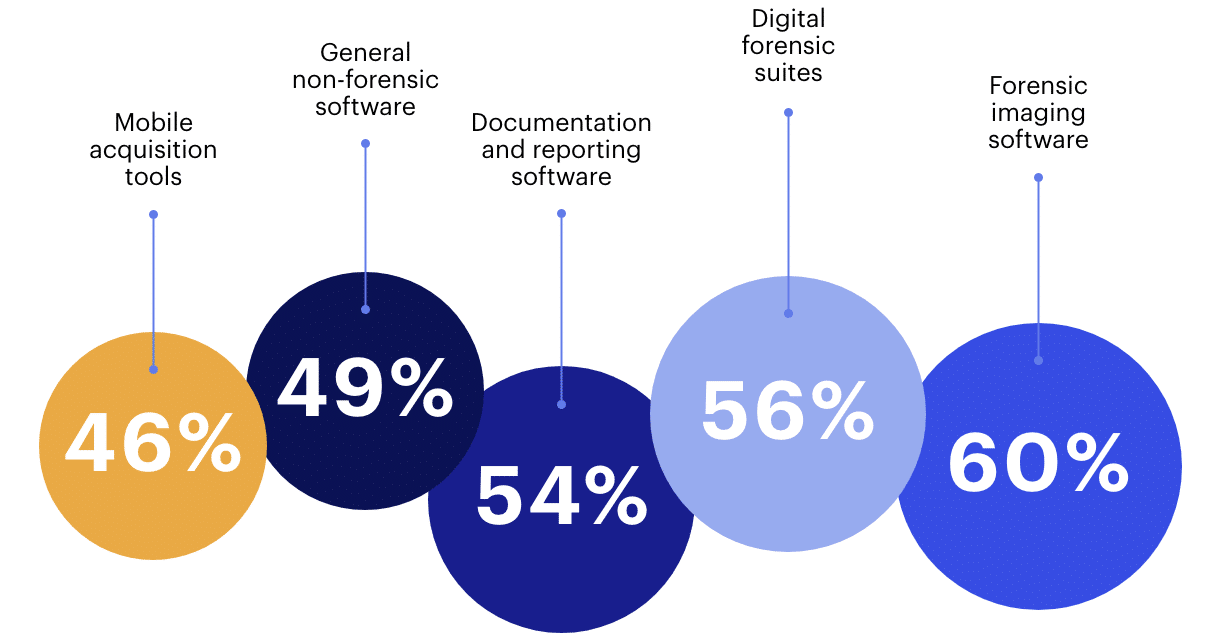
More data, from more sources, tends to mean more tools purpose-built to handle each one. Here’s where that specialization shows up most: the specific categories of tools investigators are reaching for.
Top 5 tools used by DFIR teams
Tool integration challenges in DFIR investigations
While a bigger toolkit can add capability, it also adds more places for evidence and workflows to break down between tools.
Total cost of ownership and integrating data from multiple sources are the top-cited challenges of managing multiple tools, followed by investigations simply taking more days to close and the time it takes to onboard staff onto yet another tool. Much of that integration still happens by hand: 49% of teams report manually integrating tools or using no integration points at all, and 47% rely on custom scripts.
Only about half (51%) use a dedicated digital forensics automation solution — meaning for many teams, moving evidence between tools is still a manual, ad hoc process built case by case.
The case for a consolidated DFIR toolkit
The findings point to a clear opportunity: 69% of professionals say integrating data from multiple sources is exactly what a consolidated toolkit would solve, alongside meaningful reductions in total cost of ownership.
That overlap is the real story: the two things slowing teams down most are also the two things they believe a more connected toolkit would fix. It’s less a sign that DFIR teams need another tool, and more a sign that the tools they already have need to work together better.
How Magnet Automate connects digital investigations
Magnet Automate helps bridge the gaps experienced by many DFIR teams by orchestrating automated workflows across nearly any combination of forensic, cybersecurity, and business systems, allowing teams to connect the tools they already rely on. Teams can reduce manual handoffs, eliminate repetitive tasks, and keep investigations moving without relying on custom scripts or ad hoc processes.
By automating routine work, examiners can spend more time on analysis and less time managing workflows. At the same time, security leaders gain visibility into throughput, infrastructure health, and operational performance through centralized dashboards and reporting.
What this means for enterprise DFIR teams
Investigation volumes are climbing and timelines are shrinking, which turns integration from a technical nice-to-have into an operational necessity. Teams need to move fast without cutting corners on accuracy, defensibility, or chain of custody — and a fragmented toolkit makes all three harder to guarantee.
Looking ahead, investigative effectiveness will depend less on any single tool and more on how well an entire stack works together. The teams best positioned for what’s next are treating integration as a deliberate platform decision, not an afterthought bolted onto a growing list of specialized tools.
Accelerate digital investigation workflows with automation
See how Magnet Automate can help your team connect tools, automate workflows, reduce manual effort, and scale investigations without adding complexity.
Read the full 2026 State of Enterprise DFIR report
See how 350+ DFIR professionals are rethinking mobile evidence, AI, real-time collaboration, and the toolkits that support modern investigations.