
Drone forensics: a guide for investigators
Key takeaways
- Drone forensics is the recovery and analysis of everything a drone generates in flight: flight telemetry, onboard media, sensor data, and communication artifacts, to place the device, its operator, and its purpose.
- Drone forensics breaks the instincts examiners bring from mobile forensics: a live drone can call back to its operator, physically endanger an examiner, or overwrite its own evidence just by staying powered on.
- Render safe, power off, and secure, in that order, before any extraction begins. In drone forensics, sequence and speed matter as much as technical skill.
- Drone use is growing across corrections, border security, critical infrastructure, and aviation, and forensic exploitation is showing up in a much wider range of casework as a result.
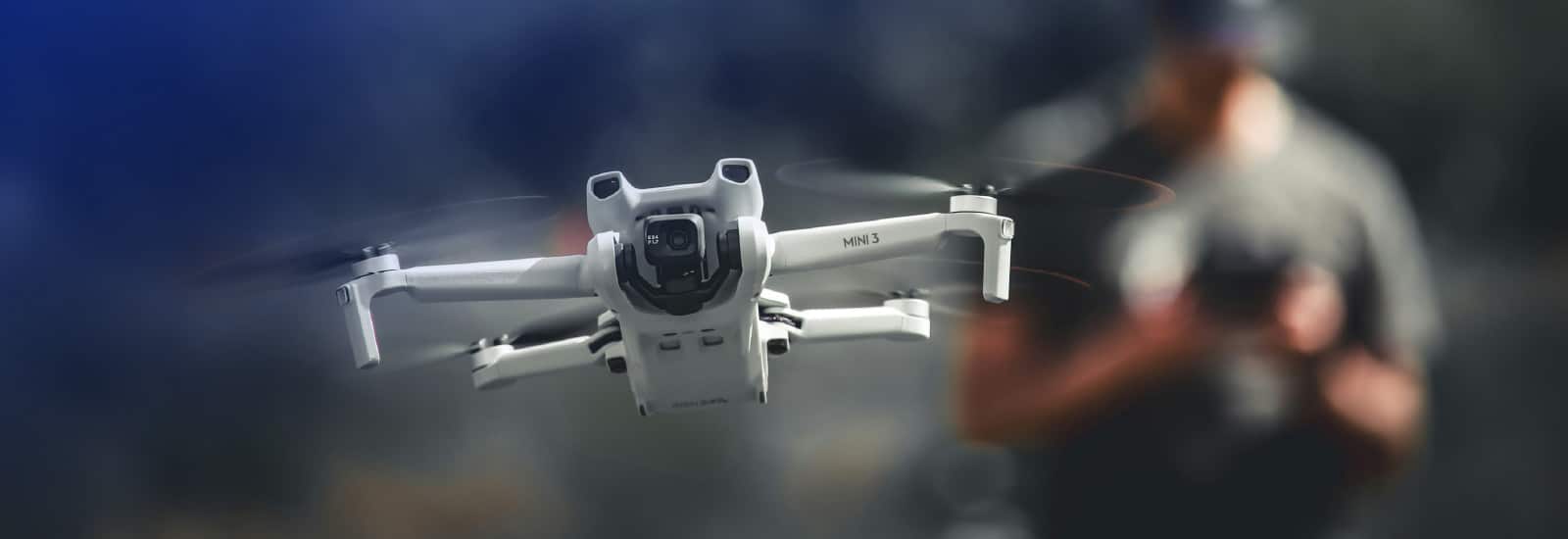
A drone that shows up in an investigation isn’t just another device. Jansen Cohoon, V2 Forensics founder and now VP of Military & Intelligence at Magnet Forensics, puts it bluntly: a drone has become “a very effective pickup truck,” capable of carrying contraband, weapons, or a camera anywhere it can fly, and getting away just as fast.
What it also carries, whether anyone realizes it or not, is a record of where it went, what it saw, and who was flying it. Drone forensics is how that record gets recovered safely and turned into evidence that holds up to scrutiny.
What is drone forensics?
Drone forensics is the process of accessing, extracting, and analyzing digital evidence from drones and other unmanned systems that operate in the air, on land, and at sea — collectively known as UxS (uncrewed systems). This includes flight data, mission data (“sorties”), and sensor data from the devices themselves, helping investigators better understand drone activity and uncover actionable intelligence.
Why drone forensics is rising in importance
Drones are showing up in far more digital investigations than they used to, for two key reasons: The technology has become affordable enough that almost anyone can use or misuse it, and adversaries have proven just how effective that low cost can be:
- Drone attacks in conflict settings rose an estimated 4,000 per cent between 2020 and 2024, according to the Center for Civilians in Conflict.
- More than 350 drone incursions were detected at 100 U.S. military installations in 2024, according to a House Oversight Committee investigation.
- Federal Bureau of Prisons incursions rose from 23 in 2018 to 479 in 2024, a roughly 20-fold increase, according to FBI testimony before the Senate Judiciary Committee.
Magnet Forensics acquired V2 Forensics in April 2026, and those figures track with what the V2 team is now seeing directly in casework at Magnet Forensics. Cohoon draws a direct comparison to military ordnance: a guided tow missile can cost $100,000 to $200,000, while a $2,000 drone rigged with an improvised explosive can be guided with similar deadly accuracy.
Cohoon has also seen this domestically. One small U.S. state, he says, logged roughly 100 drone incursions in a recent stretch, a volume most people wouldn’t expect outside a major population center.
That kind of volume doesn’t take much: a $1,000 consumer drone, a downloaded app, and an hour of setup is enough to deliver a payload, conduct surveillance, or disrupt an operation, and it leaves the same kind of digital trail a phone does. Most public safety agencies already assume drones will keep turning up in cases. What they don’t yet know is that there’s a way to get evidence off one.
How drone forensics differs from mobile and computer forensics
Examiners coming from mobile or computer forensics bring good instincts with them: preserve state, avoid contamination, document everything. But a lot of that instinct is built around keeping a phone in After First Unlock (AFU) mode and out of Before First Unlock (BFU), alive and accessible. With a drone, nearly everything points the other way.
| Area | Mobile / computer forensics | Drone forensics |
|---|---|---|
| Preservation goal | Keep the device in a usable state to maximize file system access. | Get the device off and secured as fast as possible; live handling creates more risk than it resolves. |
| Physical risk | Minimal. The device itself rarely endangers the examiner. | High. Drones are used as delivery platforms for narcotics, weapons, and explosives; treat every recovered drone as a payload platform until proven otherwise. |
| Communication risk | A phone connecting to a network can alert a suspect, but rarely in real time during examination. | Powering on a drone can trigger a live callback to its operator, who may then be watching the recovery unfold. |
| Storage behavior | Deleted data can often be recovered even after the device is used again. | Limited onboard storage means a drone left powered on will actively overwrite earlier flight data, sometimes within a single new flight. |
| Interpretation | Establishing user activity: apps, messages, browsing. | Reconstructing physical movement: requires layering flight geometry, gimbal and camera orientation, and telemetry, not just reading stored files. |
Types of evidence a drone holds
A modern consumer or commercial drone generates evidence in several places at once: the aircraft itself, its removable storage, the remote controller, and any paired app or cloud account:
- Flight telemetry and logs. GPS waypoints, altitude, speed, home point, battery status, and timestamps — reconstruct exactly where the drone went.
- Onboard media. Photos, video, and audio, often the most direct evidence of what the drone observed or delivered.
- Sensor and mission data. Gimbal and camera orientation, obstacle-avoidance events, and, on advanced platforms, full mission or “sortie” data.
- Communication and control artifacts. Records between the aircraft and controller/app — show manual vs. autonomous flight and sometimes surface the controlling device’s identifiers.
- Device and account metadata. Serial numbers, firmware versions, paired-device IDs, account activity.
6 steps to securing and preserving drone evidence
Before any extraction begins, a recovered drone needs to move through a short sequence, fast. “Off drone is safe drone,” is how Jansen Cohoon puts it. Every step here is about minimizing how long the drone stays powered on.
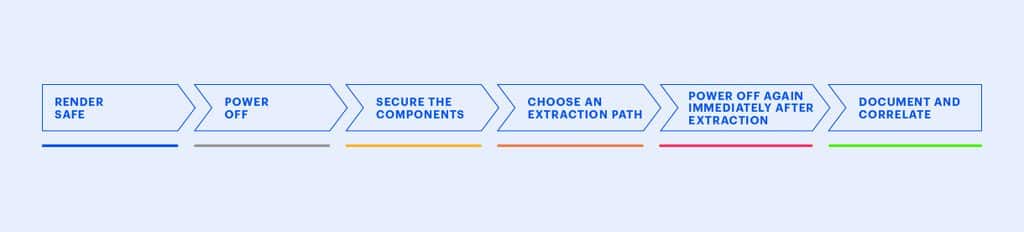
- Render safe
Treat the drone as a payload platform first and an evidence source second. Check for narcotics, explosives, biological material, or auxiliary attachments, and note any physical modifications. The drone’s factory plastic color, camera count, and battery count can also help identify make and model. - Power off
An unfamiliar or unresponsive drone should be powered down immediately. Batteries on consumer drones are inexpensively manufactured and can catch fire, and a powered-on drone is a live risk of both self-recording and a callback to its operator. - Secure the components
Remove the battery and propellers, and tape over camera sensors and lenses before any further handling or powering on. - Choose an extraction path
Field or tactical extraction, typically a direct USB connection, can recover and decrypt usable data in minutes for straightforward cases. Damaged, locked, or unsupported units may require lab-level methods such as chip-off, in-system programming (ISP), or JTAG. - Power off again immediately after extraction
Leaving a drone powered on after acquisition creates the same overwrite and callback risks as leaving it on before acquisition. - Document and correlate
Capture tool name and version, extraction method, timestamps, and any deviations from standard procedure, then correlate the recovered data with paired devices, cloud accounts, and physical evidence to build the full picture.
Emerging drone forensics use cases
As drone technology becomes further democratized and usage becomes more widespread, the use cases below will start to become part of routine casework well beyond federal and military agencies alone. State corrections, private security, and civil aviation investigators are all running into this now too.
- Correctional facilities. Drones are now a routine way to get contraband over a prison perimeter, and forensically processing the recovered device is often the only way to identify who was flying it, not just what it was carrying.
- Border security. Splitting a shipment across many small, low-risk flights limits an operator’s exposure if one is caught, which makes tracing even a single recovered drone back to a launch point disproportionately valuable.
- Critical infrastructure and VIP protection. The cost of a consumer drone is now well below the bar for causing real harm at a power plant, an airport, or a protected event.
- Delivery and commercial airspace. As drone delivery scales, incident investigation will start to look more like aviation accident investigation: independent and evidence-driven, not run by the manufacturer.
- Military and national security. A recovered adversary drone can hold more operational intelligence, launch points, mission planning, and communication protocols than any single detection event ever will.
Common drone forensics pitfalls to avoid
These are the mistakes examiners run into most often in drone cases, and nearly all of them trace back to the same two instincts carried over from other forensics disciplines: powering on a drone before it’s secured, and treating a recovered drone like ordinary hardware instead of a live evidence source.
- Powering on an unfamiliar drone before render-safe and isolation steps are complete.
- Leaving a drone powered on longer than necessary, risking both callback and self-overwrite of evidence.
- Booking a seized drone as a hardware exhibit only, without attempting forensic extraction.
- Assuming a single detection event captures a drone’s full flight history, rather than treating detection and forensic exploitation as complementary.
- Overlooking the controller, companion app, and any paired mobile devices, which often hold artifacts the aircraft itself doesn’t.
- Treating every case as aerial by default, and missing land, surface, or subsurface systems relevant to the investigation.
Learn more
A strong drone forensics investigation rarely depends on the aircraft alone. It brings together flight telemetry, onboard media, sensor data, the controller and companion app, and any paired cloud accounts or mobile devices to build a record that holds up to scrutiny. That record is what turns a recovered drone into a lead, and as drone use keeps expanding into new corners of casework, that kind of correlation is becoming standard practice rather than a specialty.
Learn more about Magnet Forensics’ military and defense solutions.