

Key insights
AI is raising the bar—and the stakes—of digital investigations
The need for real-time collaboration is becoming a central driver for SaaS adoption
Mobile evidence is indispensable—and increasingly challenging to access
As toolkits expand, integration is becoming a defining factor in investigations
The pace and complexity of enterprise digital investigations into internal and external threats are forcing investigation models to adapt.
Advances in AI, the shift towards SaaS-based solutions, the increasing importance of mobile evidence, and the expanding complexity of digital forensics and incident response (DFIR) toolsets are collectively changing how investigations are conducted—and raising expectations for how quickly and confidently teams must act.
AI stands out as the most transformative force shaping this shift for 2026. It is enabling analysts to process larger volumes of data, surface patterns faster, and scale their work in new ways. At the same time, AI technologies are also being leveraged by malicious actors, increasing the sophistication and speed of digital threats.
For digital investigation teams, the implication is clear: Access to the right data, the ability to collaborate in real time, and the integration of tools across the investigative stack are increasingly shaping how investigations move forward, and at what pace.
Our sixth annual State of Enterprise DFIR report draws on a comprehensive survey of private sector DFIR professionals. Together, the results point to a clear shift in how digital investigations are being conducted. Here, we examine the forces driving that shift and the four defining trends shaping enterprise digital investigations in 2026.
68%
of respondents are already using AI as part of their investigations.
24%
Year-over-year increase in number of respondents citing real-time collaboration as a reason for adopting SaaS solutions.
53%
Percentage of respondents citing only being able to extract limited data from mobile devices as a top mobile-related challenge.
29%
Year-over-year increase in the number of tools investigators use in their investigations.
The shape of enterprise
investigations today
Whether working in-house at an enterprise organization or for a third-party forensic services provider (FSP), DFIR professionals support three primary types of investigations.
Incident response
- Phishing and BEC
- Malware and ransomware
- Data exfiltration and IP theft
Internal investigations
- Regulatory compliance
- Asset misuse & policy violations
- Departing employees
- Misconduct
- Internal fraud
eDiscovery
- Legal holds / ESI protocol
- Litigation
42%
30.4%
22.1%
The top challenges facing forensic investigators today cover a range of issues—from data volume to hiring obstacles.
Top six investigative challenges
Percentage of respondents who cited challenges as problematic for investigations.
Increasing volume of investigations & data
Evolving cyber attack techniques
Budgetary constraints
Time-consuming repetitive tasks
Hard to retain skilled talent
Shortage of expertise


The signal
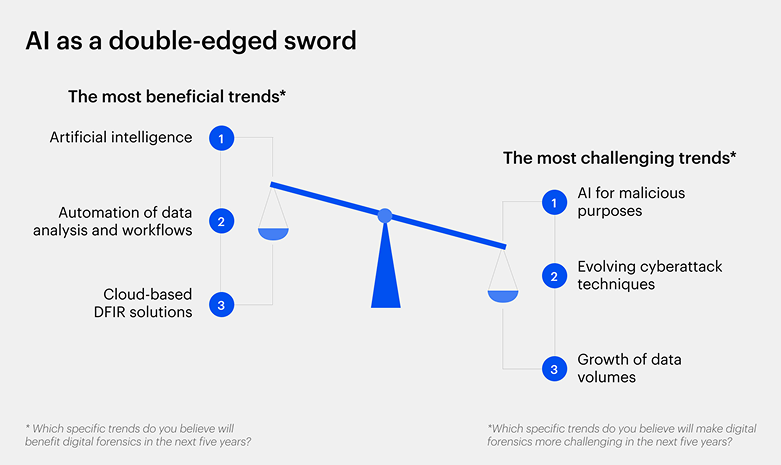
Artificial intelligence technologies have rapidly moved to the forefront of the digital investigation landscape, offering transformative capabilities to help investigators uncover the truth faster. What distinguishes this shift is not just the pace of adoption, but the dual role AI now plays.
In the hands of digital investigators, AI is a powerful tool that helps investigations move faster, and scale more effectively, by taking on manual, time-consuming, and repetitive tasks. In the hands of malicious actors, those same technologies can enable sophisticated, stealthy, and highly scalable attacks that bypass traditional defenses.
Many of the DFIR professionals surveyed viewed AI as both the greatest opportunity—and the greatest emerging challenge—in digital investigations.
A strong majority of respondents—68%—already use AI in their digital investigations, representing a remarkable increase from just two years ago. However, human intuition, creativity, and judgment remain critical. AI technologies are largely being used to aid—not replace—the experts who bring life experience and well-honed judgment to investigations.
A leap in AI use in digital investigations
Dividing and conquering
The top three cited uses of AI in investigations:
- Analyzing text and images
- Pattern recognition
- High-accuracy data classification
The top three activities that require human intuition and judgment:
- Evidence collection
- Initial case assessments
- Data analysis
Why it matters now
The AI shift is happening faster than organizations can establish shared norms around validation, accountability, and risk. In this environment, investigative advantage is no longer determined by whether AI is used—but by how responsibly, transparently, and strategically it is applied.
As organizations continue to equip their examiners with AI-powered solutions, experience and expertise remain critical for investigations, with humans providing informed direction to purpose-specific AI technologies.
AI adoption is also reshaping what it means to investigate responsibly. DFIR professionals who have not yet adopted AI cited several concerns related to its use in investigations, including:
- Security considerations
- Concerns about result validity
- Legal considerations
- Concerns around collection of personal data
As we look ahead in 2026 and beyond, the need to balance progress with prudence has never been stronger.
Balancing progress with prudence
The top six measures DFIR professionals using AI have implemented to ensure compliance with relevant legislation:
- Ensuring data is secure
- Receiving informed consent for AI usage
- Training staff
- Conducting regular audits of AI systems
- Aligning on AI use cases
- Collecting only essential information
“Organizations are approaching AI with intent—using it for scale and efficiency, while keeping validation, oversight, and decision-making firmly with their digital investigation teams.”
Trey Amick, VP, Product & Technical Marketing, Magnet Forensics

The signal
Efficiency, flexibility, and scalability remain top drivers of SaaS adoption in digital investigations. However, the fastest-growing signal this year is the need for real-time collaboration across investigation teams and their stakeholders.
As investigations grow more complex and distributed—spanning geographies, functions, and teams—DFIR professionals are placing greater emphasis on tools that allow multiple stakeholders to work together on the same data, at the same time.
24%
Year-over-year increase in number of respondents citing real-time collaboration as a reason for adopting SaaS-based investigative solutions.

The ability to collaborate in real time recorded the largest proportional year-over-year increase among reasons for adopting SaaS-based investigative solutions. In our conversations with DFIR leaders, many note that while SaaS tools were often adopted for other reasons—reducing data duplication and administration, speeding up investigations—another significant advantage emerged in practice: improved collaboration and shared visibility across cases.
The ability to scale up or down as needs vary also emerged as a key benefit, with more than three quarters of respondents agreeing that SaaS-based solutions support this requirement. At the same time, nearly the same number of respondents cited data residency and security requirements as important considerations that must be addressed.
80%
Percentage of respondents who agree that “SaaS-based solutions will allow us to scale up or down as required.”
79%
Percentage of respondents who agree that “Meeting data residency and security requirements are essential when considering a SaaS-based solution.”
While SaaS adoption is increasing as organizations modernize their approach to digital investigations, many organizations report challenges integrating SaaS tools with existing workflows and on-premises systems—slowing time to impact and limiting the full benefits of shared, real-time work.
Those already using SaaS-based solutions cited difficulties integrating with existing systems, along with securing support from IT, as the most challenging aspects of adoption, highlighting the need to consider how to integrate new capabilities with an existing tech stack to address the challenges.
“As investigations become more complex and distributed, DFIR teams are increasingly prioritizing SaaS tools that let multiple stakeholders work on the same data, in real time—because that’s what modern incident response demands.”
Lyn Hinsch, Platform Consultant, Magnet Forensics
Why it matters now
For digital investigators, collaboration is no longer a “nice to have.” It is becoming a prerequisite for keeping pace with investigation volumes, timelines, and stakeholder expectations.
As more investigations involve cross-functional teams, the ability to work from a shared investigative view increasingly shapes both efficiency and confidence in outcomes.
Looking ahead, the findings suggest that the success of SaaS adoption will depend on how seamlessly these solutions support collaborative workflows across the investigative lifecycle, and allow organizations to scale up and down as needs dictate. Platforms that reduce friction between teams, preserve data integrity, and integrate cleanly with existing environments will deliver the most value as investigative demands continue to accelerate.

Mobile devices continue to play a central role in digital investigations. From messaging and communications to application data and location history, mobile evidence often provides some of the most direct insight into user behavior and intent. Survey results reinforce this importance, with respondents consistently citing mobile devices as a critical source of evidence.
At the same time, access to mobile data is becoming more complex. Operating system changes, enhanced security controls, evolving privacy expectations, and regulatory requirements are reshaping what investigators can collect, how they collect it, and under what conditions.
61%
Percentage of respondents who reported that their digital investigations either always or often require using a forensic tool to collect data from mobile devices and tablets.
66%
Percentage of respondents who say the number of mobile devices in investigations is growing.
Encryption, device security features, and privacy requirements are among the most prominent factors impacting investigative workflows and timelines. Slightly more than half of respondents (53.3%) report being able to acquire only limited data from mobile devices. This is the third consecutive year that it has been cited as the most common mobile-related challenge.
Several factors contribute to this constraint, including using tools that don’t support the latest operating system releases, and legal or policy restrictions designed to safeguard employee privacy. Nearly half of the DFIR professionals surveyed report that mobile device management (MDM) controls have impeded their investigations by preventing access to needed data.
Top challenges with mobile collection and analysis:
- Limited data extracted from the device (53%)
- Inability to gain access to the device due to MDMs (48%)
- Access and extraction take too much time (47%)
“Mobile evidence is indispensable to modern investigations, offering direct insight into user behavior through messaging, app data, and location history. Yet with evolving operating systems and strengthened security and privacy controls, accessing this crucial mobile data has become increasingly complex for investigators.”
Jeff Rutherford, Forensic Consultant
Why it matters now
For investigative teams, mobile evidence represents a growing paradox: it is both indispensable and increasingly governed by safeguards designed to protect users and organizations. While mobile data remains central to modern investigations, investigators must adapt their approaches and tools to operate effectively within a more regulated and technically complex environment.
As access conditions evolve, investigative effectiveness will depend on the ability to navigate permissions, preserve evidentiary integrity, and maintain compliance—without compromising speed or confidence in outcomes. Keeping technology stacks current will also be essential, particularly as new mobile operating systems introduce changes that affect data access and extraction.
Looking ahead, the findings suggest that successful mobile investigations will hinge on approaches that balance evidentiary value with privacy, security, and legal obligations. This balance becomes especially critical in bring-your-own-device (BYOD) environments, where mobile devices often contain a mix of corporate and personal data.

The signal
Digital forensics toolkits continue to expand as investigators adopt specialized tools to address new data sources, investigative techniques, and compliance requirements. This diversification reflects both the growing complexity of digital investigations and the availability of more purpose-built solutions.
Survey results show a significant year-over-year increase in the number of tools used in enterprise investigations, with respondents reporting an average of 7.1 tools used, up from 5.5 just a year ago.
At the same time, respondents indicate that managing a growing number of tools is introducing new friction into investigative workflows.
29%
Year-over-year increase in the average number of tools used in enterprise DFIR investigations

Tools used in digital investigations
Bubbles proportionately represent the number of respondents who said they are using each individual tool.
While many organizations value the range of capabilities that come with a broader toolkit, respondents also cited challenges that slow investigations and increase operational overhead. These include difficulties integrating data from multiple sources, limited support for integrated reporting, and challenges correlating outputs across tools.
As DFIR stacks become more layered, a platform approach that connects tools, workflows, and data is emerging as a critical factor in investigative efficiency. DFIR professionals increasingly point to approaches that combine case management, automation, and integration capabilities to reduce friction across the investigative lifecycle.
The most frequently cited benefits of a more consolidated approach include simpler multi-source collection, integrated reporting, and lower total cost of ownership.
“The proliferation of specialized DFIR tools mirrors the evolution of digital evidence itself. Investigators require purpose-built capabilities to extract forensic value from various sources. The diversification of tools isn’t merely about having more tools; it’s about having the right tools to handle increasingly complex investigative scenarios.”
Doug Metz, Senior Security Forensics Specialist, Magnet Forensics
Why it matters now
As investigation volumes increase and timelines compress, integration is becoming not just a technical consideration but an operational one. Investigators are under growing pressure to move quickly while maintaining accuracy, defensibility, and chain of custody across increasingly complex workflows.
Looking ahead, the findings suggest that investigative effectiveness will depend less on individual tools and more on how well they work together. A modern DFIR platform that can simplify operations through automation, case management, and consolidated KPIs, and preserve context across stages of an investigation will better position investigative teams to keep pace as investigative demands continue to evolve.
What’s next for enterprise investigations
Enterprise digital investigations are entering a new phase—one defined by acceleration and constraint in equal measure. AI is raising the bar on what investigation teams can process and uncover, while simultaneously increasing the speed, scale, and sophistication of digital threats. This duality sits at the center of the year ahead: the same technologies that strengthen investigations are also reshaping the risks they must confront.
In this environment, investigative readiness is no longer just a technical concern—it is a leadership one. The ability to respond effectively will depend on how organizations equip their investigation teams to operate at scale: aligning tools, workflows, governance, and talent in ways that support speed without sacrificing defensibility, transparency, or trust.
Looking ahead, the opportunity lies in building investigative capabilities that are adaptable by design. Organizations that invest in responsible AI use, real-time collaboration, integrated toolchains, and scalable workflows will be better positioned to meet rising investigative demand—turning complexity into clarity as enterprise investigations continue to evolve.

Survey demographics and methodology
This report is informed by a web-based survey of private sector digital forensics and incident response (DFIR) professionals conducted from October 2, 2025 through November 3, 2025.
A total of 368 respondents completed the survey. Their responses were aggregated anonymously to provide information most relevant to the needs of enterprise decision-makers.
To ensure this study reflects a range of viewpoints, the respondents included a mix of DFIR experience, workplace role and seniority, and organization type and size.
8.1
Years worked in DFIR (average).