

Forensic Early Case Assessment: Why the evidence must come first
Key insights
- Forensic Early Case Assessment applies digital forensic methods upstream of large-scale collection and review, not after, so evidence shapes scope, preservation, and review strategy from the start.
- The goal isn’t collecting less data. It’s collecting the right data: some matters narrow, others expand, based on what the evidence actually shows.
- Defensibility starts at collection, not at review: chain of custody, provenance, and documentation established early hold up when decisions are challenged later.
An evidence-first approach to eDiscovery
Early Case Assessment (ECA) has become a critical part of modern eDiscovery. By helping organizations understand scope, costs, risks, and case strategy before full review begins, ECA enables smarter decisions earlier in the discovery process.
However, most ECA workflows begin after data has already been collected and loaded into a review platform. While valuable, this approach assumes that the right information has already been identified, preserved, and collected.
In today’s digital environments, that assumption may not hold.
Key evidence may reside across endpoints, mobile devices, cloud applications, collaboration platforms, system logs, metadata, and deleted records that never make it into a traditional document collection. At the same time, organizations struggle with growing data volumes, increasing review costs, privacy concerns, and the risk of missing relevant evidence.
Forensic Early Case Assessment (Forensic ECA) extends ECA further upstream by applying digital forensic methods before large-scale collection and review occur. It helps organizations identify, validate, contextualize, and prioritize evidence earlier so that downstream review efforts begin with the strongest possible foundation.
Scope vs. Early Case Assessment (ECA)
Before discussing Forensic ECA, it’s important to distinguish between two closely related concepts: scoping and Early Case Assessment.
Scoping establishes the boundaries of a matter by identifying relevant custodians, devices, systems, data sources, and timeframes.

Early Case Assessment builds on that foundation by evaluating the information available to understand potential costs, risks, relevance, and case strategy.

Scoping determines where to look. ECA helps determine what the information means.
The challenge is that effective ECA depends on collecting the right evidence in the first place. If important evidence is missed, over-collected, or stripped of context during acquisition, even the most sophisticated review platform can only analyze what it receives.
What is Forensic Early Case Assessment?
Traditional ECA begins after collection. Forensic ECA begins before collection decisions are finalized.
It applies digital forensic techniques early in the discovery process to help organizations identify the most relevant evidence, validate assumptions, establish context, and reduce unnecessary downstream volume.
At its core, Forensic ECA asks a simple but critical question:
Before asking how quickly a dataset can be reviewed, have we confirmed that it’s the right dataset?
Rather than treating collection as a completed step, Forensic ECA treats collection decisions as part of the assessment process itself. Evidence informs scope, collection, preservation, and review strategy from the beginning.
The result is a more informed, evidence-driven approach that improves both efficiency and defensibility throughout the eDiscovery lifecycle.
Why traditional ECA may start too late
Today’s investigations rarely involve just documents and email.
Evidence may exist across:

Traditional ECA solutions excel at helping legal teams analyze information after it enters a review platform. However, they generally operate under the assumption that the collection phase has already captured everything needed.
That assumption creates risk. If relevant evidence was never collected, review teams cannot analyze it. If large volumes of irrelevant information were collected, organizations conduct unnecessary processing, hosting, review, and privacy costs. And if critical activity data was lost during acquisition, reviewers may lack the context needed to fully understand what occurred.
Forensic ECA helps eliminate these blind spots by introducing investigative analysis earlier in the process. Instead of focusing only on documents, organizations can begin asking:
- What evidence actually exists?
- What information may be missing?
- What systems were involved?
- What activity occurred before, during, and after the event?
- What can be defensibly excluded?
By answering these questions earlier, legal and investigative teams can move into review with greater confidence and less uncertainty.
The five benefits of Forensic ECA

One of the most immediate benefits of Forensic ECA is improved scope accuracy.
Early in a matter, organizations often operate with incomplete information. To avoid missing evidence, teams frequently preserve or collect broad sets of mailboxes, devices, repositories, and date ranges.
While understandable, this approach often creates unnecessary volume and additional cost.
Forensic ECA reduces uncertainty before major collection decisions are made. By examining evidence early, investigators can identify the people, devices, systems, applications, and timeframes most relevant to the matter. Scope becomes driven by evidence rather than assumptions.
Sometimes this narrows the collection. Sometimes it expands it. Either outcome is valuable because the objective is not simply collecting less data. The objective is collecting the right data.
The result is a more defensible evidence population that balances completeness with efficiency.
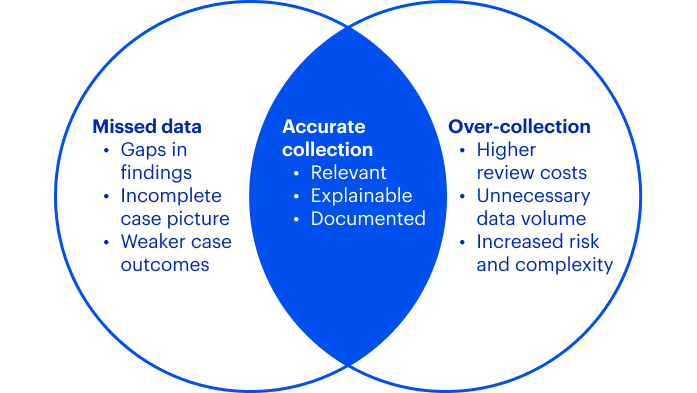

Collection determines how much of what’s within that scope is actually acquired — and that’s a separate decision with its own cost and risk implications.
Forensic ECA focuses on making smarter collection decisions before the data enters review systems. This may include:
- Evidence-informed date ranges
- Targeted acquisition strategies
- Validation of data sources
- Early exclusion of irrelevant information
- Focused collection efforts
The result is higher-quality evidence entering the eDiscovery workflow.
Reducing unnecessary data before processing can help lower hosting costs, review complexity, and overall discovery expenses.
There are also important risk management benefits.
Modern devices often contain large amounts of personal, sensitive, privileged, or unrelated information. Broad collection strategies may inadvertently acquire data that has little relevance to the matter while introducing additional privacy and regulatory challenges.
By using evidence to accurately define scope before collection, organizations can support data minimization efforts while reducing unnecessary risk exposure.

Documents tell part of the story. Evidence tells the whole story.
A document may indicate that information existed, but it often does not explain how that information was created, accessed, transferred, modified, or deleted.
This is where digital forensics adds value.
Forensic ECA helps uncover context through sources such as:
- Metadata
- System logs
- Application records
- Timeline artifacts
- Mobile device evidence
- Deleted content
Together, these artifacts create a richer understanding of what actually occurred.
For example, a review may reveal that a confidential file exists. A forensic assessment may reveal far more:
- Was the file copied to removable media?
- Was it synchronized to a cloud account?
- Was remote access involved?
- Was the file deleted afterward?
- Did activity occur outside the original review scope?
These insights help investigators move beyond content and understand behavior, chronology, and intent.
As evidence becomes increasingly distributed across cloud platforms, mobile devices, and modern workplace applications, this context has become essential for effective decision making.

Every investigation begins with assumptions.
- A particular user is believed to be involved.
- A device is assumed to contain evidence.
- A timeframe is selected.
- A repository appears relevant.
Some assumptions prove accurate. Others do not.
Forensic ECA helps test these assumptions before significant review costs are incurred.
By validating timelines, confirming device usage, identifying evidence locations, and verifying activity patterns, organizations can determine whether the original theory of the matter is supported by evidence.
This validation improves both decision quality and efficiency.
Just as importantly, it reduces the likelihood of late-stage surprises.
Finding out during review that the wrong custodian was identified, a cloud repository was overlooked, or a critical date range was excluded can trigger expensive recollection, reprocessing, and additional review cycles.
Forensic ECA helps uncover those gaps earlier, when corrective action is less costly and less disruptive.

Defensibility is often associated with review processes, production decisions, and disclosure obligations.
In reality, defensibility begins much earlier.
Organizations are frequently asked to explain:
- Where evidence originated
- How it was collected
- Why certain sources were included
- Why others were excluded
- Whether metadata was preserved
- How decisions were documented
Forensic ECA helps answer these questions through proven forensic practices.
Controlled acquisition, evidence validation, chain of custody, provenance tracking, and comprehensive documentation establish transparency throughout the evidence lifecycle.
When challenged, organizations can explain not only what was reviewed, but why specific collection and scoping decisions were made.
That transparency strengthens confidence in the overall discovery process.
Forensic ECA as the evolution of Early Case Assessment
Early Case Assessment was created to help organizations make better decisions sooner. Forensic ECA extends that same philosophy further upstream.
As digital evidence becomes more complex and more broadly distributed, assessment must begin closer to the original evidence sources. As review costs continue to rise, culling decisions should happen earlier. As defensibility expectations increase, documentation and validation should begin during collection rather than after review starts.
Forensic ECA does not replace traditional ECA. It makes traditional ECA more effective. By ensuring the right evidence enters review, organizations can get greater value from downstream analytics, review platforms, and legal workflows.
Let the evidence shape the review
The challenge facing eDiscovery teams today is not simply managing larger volumes of information.
It’s identifying the right evidence earlier, preserving context across increasingly complex data sources, controlling collection scope, and making defensible decisions throughout the lifecycle of a matter.
Forensic Early Case Assessment addresses these challenges by moving critical evidence decisions closer to the beginning of the process.
It helps organizations distinguish between available data and relevant evidence, uncover information that might otherwise be missed, and enter review with greater confidence that the right information has been identified and preserved.
Ultimately, the principle behind Forensic ECA is simple:
The evidence should shape the review, not the other way around.
When organizations start with the right evidence, every step that follows becomes more effective, more efficient, and more defensible.
Learn more about digital forensics for eDiscovery
Learn how digital forensics can strengthen Early Case Assessment and improve your eDiscovery outcomes.