

Forensic Early Case Assessment: is eDiscovery collecting the right data?
Key takeaways
- Forensic Early Case Assessment applies digital forensic collection, validation, and analysis before data enters review, not after. That shifts the question from “how fast can this be reviewed?” to “is this the right data?”
- Forensic ECA strengthens, not replaces, traditional ECA, analytics, and review by improving the quality and completeness of what feeds into them.
- Testing assumptions early avoids costly late-stage surprises, such as recollection, reprocessing, and revised timelines, and builds a documented, defensible record from the start.
Speed and cost control matter in eDiscovery, but they only pay off if the team is reviewing the right data. That’s the question Forensic Early Case Assessment (Forensic ECA) answers before review even starts.
Getting there starts with a line that’s easy to blur: scoping and Early Case Assessment (ECA) are related but distinct steps in an investigation or legal matter.
Scoping defines the boundaries by identifying relevant custodians, data sources, systems, activities, and timeframes — it establishes what should be examined.
ECA builds on that foundation, evaluating the available information to assess risk, relevance, cost, and legal strategy — determining what the evidence means and what should happen next.
In simple terms, scoping determines where to look, while ECA helps determine what the information means. The two processes are closely connected: effective ECA depends on a well-defined scope, and ECA findings often lead teams to refine, expand, or narrow the scope as a matter develops.
What is Forensic Early Case Assessment?
Traditional Early Case Assessment (ECA) has long played an important role in eDiscovery by helping legal and investigative teams understand the potential cost, scope, risks, and likely direction of a matter before committing significant resources to review. Historically, however, this assessment has often begun only after data has already been collected, processed, and loaded into a review environment.
That approach remains valuable, but relies on a critical assumption: that the right data has already been collected. In today’s environments, that assumption deserves closer examination.
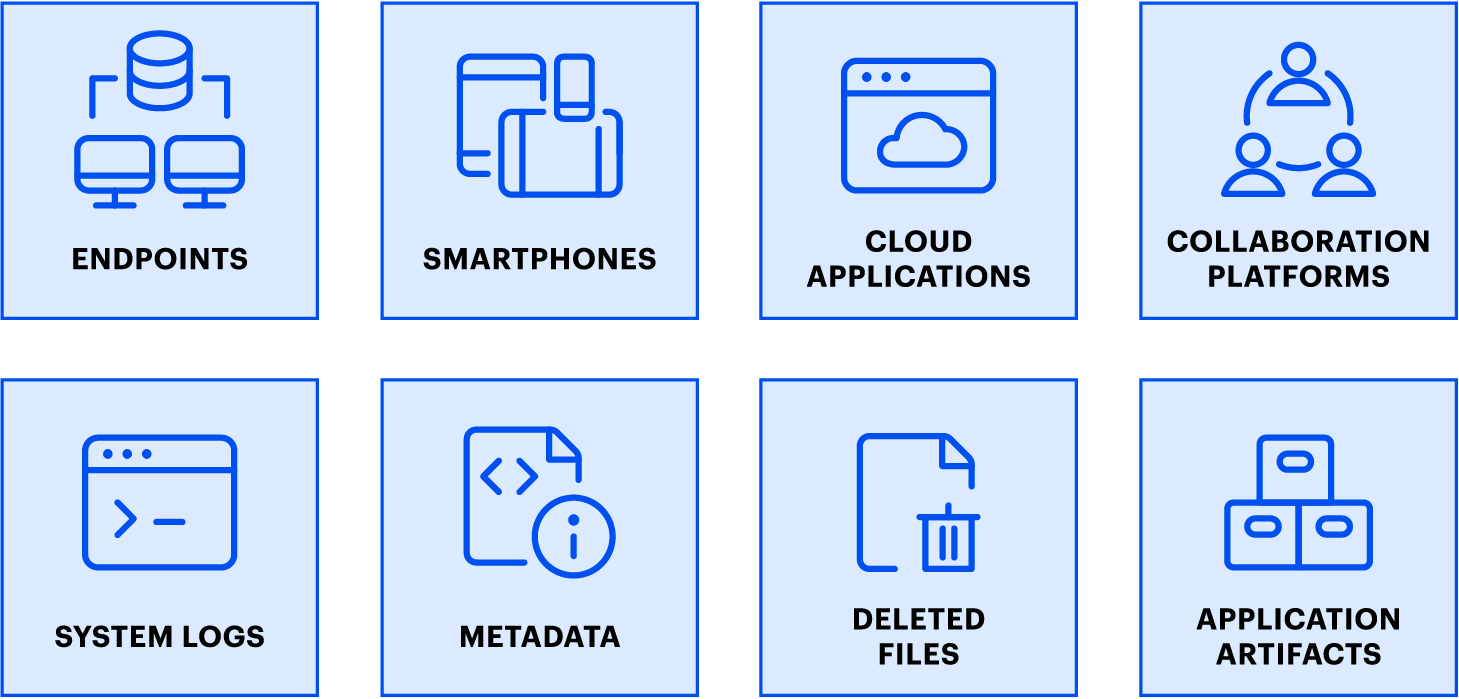
Relevant evidence may exist across endpoints, smartphones, cloud applications, collaboration platforms, system logs, metadata, deleted files, and application artifacts that may never appear in a traditional document collection.
At the same time, broad collections can increase review costs, processing requirements, privacy exposure, and overall complexity.
Forensic Early Case Assessment (Forensic ECA) extends the concept of ECA further upstream in the discovery process. It applies digital forensic collection, validation, analysis, and evidence scoping techniques before large volumes of data enter downstream review workflows.
Rather than beginning assessment only after collection, it introduces investigative thinking into the decisions surrounding preservation, collection, exclusion, and validation of evidence.
The core principle is simple: Before asking how quickly a dataset can be reviewed, first determine whether it is the right dataset.
Forensic ECA does not replace traditional ECA, analytics, or document review. Instead, it strengthens those activities by improving the quality, completeness, relevance, and context of the data entering later stages of the eDiscovery process.
Why traditional ECA may start too late
The eDiscovery lifecycle is often described as a sequence that begins with identification and preservation before moving through collection, processing, review, analysis, production, and presentation. However, matters rarely progress in a perfectly linear fashion. New evidence changes assumptions, new custodians emerge, and previously unknown data sources may become important.

The challenge is that mistakes made during collection often become more expensive as data moves downstream. If relevant information is never collected, later analytics and review teams can’t find it. If excessive amounts of irrelevant data are collected, organizations must absorb unnecessary processing, hosting, searching, review, and privacy management costs. If critical context is lost during acquisition, reviewers may see content without understanding the surrounding circumstances.
Traditional ECA focuses on information that has already entered a review platform. Forensic ECA complements that approach by introducing investigative questions earlier.
Instead of only asking what documents match certain criteria, it asks broader questions:
- Where should we be looking?
- What evidence actually exists?
- What information may be missing?
- What activity occurred around the evidence?
- What can be defensibly excluded?
By addressing these questions earlier, organizations can improve scope accuracy, reduce unnecessary downstream effort, and build a stronger understanding of the matter before review begins.
Five key benefits of Forensic ECA
1. More accurate scoping
One of the most significant benefits of Forensic ECA is improved scope accuracy.
Many collection decisions begin in conditions of uncertainty. Legal and investigative teams may preserve or collect broad sets of information — including entire mailboxes, endpoints, cloud repositories, file shares, and lengthy date ranges — because they don’t know where relevant evidence resides.
Forensic analysis helps reduce that uncertainty by providing evidence before major collection decisions are finalized. A targeted examination may identify relevant users, time periods, applications, storage locations, communications, connected devices, or behavioral patterns that help organizations make more informed collection decisions.
As a result, matters that initially appear to require extensive preservation and collection efforts may ultimately be narrowed to a specific account, device, application, timeframe, or sequence of events. Conversely, a seemingly straightforward matter may reveal previously unknown evidence sources such as mobile applications, cloud services, remote access platforms, or removable media.
This is why Forensic ECA shouldn’t be solely viewed as a cost reduction exercise. Its primary purpose is improving scope accuracy. Collecting less data is only beneficial if the right evidence is still captured. The goal is a defensible evidence population that is comprehensive enough to preserve what matters while avoiding unnecessary downstream burden.
2. Better understanding of evidence
A key distinction in Forensic ECA is the difference between data availability and evidentiary understanding.
The existence of a document does not automatically explain its significance. A file may appear in a collection, but additional artifacts may reveal that it was copied to removable media, synchronized to a cloud service, opened through a specific application, or deleted shortly before collection. Similarly, a message export may contain conversation text while omitting metadata, deleted content, application records, or other contextual information that helps explain what occurred.
Digital forensic analysis expands the available picture by examining evidence sources such as:
- Metadata
- System logs
- File systems
- Application records
- Timeline artifacts
- Mobile device evidence
- Deleted content
- Validation data
Together, these sources help explain activity that may not be visible through documents alone.
Rather than simply identifying information, Forensic ECA provides context surrounding how that information was created, accessed, modified, transferred, or deleted.
This capability becomes particularly valuable as organizations increasingly rely on cloud services, collaboration platforms, mobile devices, and specialized business applications.
Evidence is now distributed across multiple systems and often exists in formats that do not fit traditional document review models. Metadata, databases, logs, configuration records, cached files, and application artifacts may all provide important context.
Consider a matter involving suspected transfer of confidential information. Traditional review may identify the relevant documents and communications. A forensic assessment, however, may answer additional questions:
- Was removable media connected?
- Were files compressed before transfer?
- Was cloud synchronization involved?
- Was remote access used?
- Were files deleted afterward?
- Did activity occur outside the original timeframe?
These insights do not replace review. They help ensure review is informed by a more complete and accurate understanding of the underlying events.
3. Earlier validation of assumptions
Most investigations begin with assumptions. A particular individual is believed to be involved, a specific device is thought to contain relevant evidence, a date range is selected based on recollection, or a cloud repository is assumed to hold the key information. Some of those assumptions will prove accurate. Others will not.
Forensic ECA provides an opportunity to test those assumptions before significant discovery costs have been incurred.
Early forensic analysis can validate timelines, confirm device usage, verify evidence locations, identify transfer activity, and determine whether expected artifacts actually exist. It can also uncover information that contradicts the original theory of the matter, allowing teams to adjust direction before substantial investments are made in downstream review.
This early validation improves both efficiency and decision quality. Matters are less likely to be built around incomplete evidence or inaccurate assumptions, and investigative resources can be directed more effectively.
The benefit becomes even more apparent when considering the cost of late stage surprises. Discovering halfway through review that the wrong device was collected, a communication platform was overlooked, a key date range was missed, or a cloud service was excluded often requires recollection, reprocessing, additional review, revised timelines, and potentially significant strategy adjustments.
Forensic ECA can’t eliminate all surprises, but it helps identify evidence gaps and collection weaknesses earlier, reducing the likelihood that major issues remain undiscovered until later stages of the matter.
4. Smarter collections with lower risk
Document review remains one of the most resource intensive parts of many eDiscovery matters. Traditional volume reduction techniques often focus on reducing data only after collection through methods such as keyword searching, deduplication, analytics, clustering, and technology-assisted review.
Forensic ECA approaches the challenge earlier in the lifecycle.
Rather than focusing exclusively on reducing data after collection, it asks whether some unnecessary data can be avoided before it enters downstream systems.
This may involve:
- More targeted acquisition strategies
- Evidence-informed date ranges
- Collection from validated sources
- Early exclusion of irrelevant information
- Focused collection of specific categories
- Early filtering while context remains available
This approach can significantly reduce processing requirements, hosting costs, review effort, and overall complexity. More importantly, it improves the quality and relevance of the information that does move downstream.
There are also important privacy benefits. Modern devices and cloud platforms often contain significant amounts of personal or unrelated data. Broad collection efforts may inadvertently capture sensitive communications, privileged information, health records, location data, or information belonging to unrelated individuals.
By identifying likely evidence sources earlier, organizations may be able to narrow collection parameters and reduce unnecessary acquisition of irrelevant information. This supports data minimization objectives while helping organizations reduce privacy, security, and regulatory risks.
Importantly, Forensic ECA does not suggest that narrow collections are always appropriate. Some matters require broad preservation and extensive acquisition. The advantage is that scope decisions can be guided by evidence rather than assumptions.
5. Stronger defensibility
Defensibility is often discussed in relation to search terms, review processes, and production decisions. However, defensibility begins much earlier in the eDiscovery lifecycle.
Questions frequently arise about:
- Where evidence originated
- How it was collected
- Whether metadata was preserved
- Why certain sources were included or excluded
- How collection decisions were made
Forensic ECA helps create a documented and defensible record of those decisions. Digital forensic methods emphasize controlled acquisition, evidence validation, preservation of context, chain of custody, provenance, and documentation. These practices support transparency throughout the evidence lifecycle.
When applied early, they enable organizations to explain not only what entered review, but why it entered review and how those decisions were reached. This level of transparency can become especially valuable when discovery scope, collection methodology, or evidence handling practices are challenged.
Forensic ECA as an evolution of early case assessment
Early Case Assessment emerged because waiting until the end of discovery to understand a matter is inefficient and risky. Its purpose has always been to create clarity earlier in the process.
Forensic ECA extends that same principle further upstream.
As evidence becomes increasingly distributed across endpoints, cloud platforms, mobile devices, and specialized applications, assessment must move closer to the original evidence sources. As collection becomes more technically complex, scoping decisions should be informed by forensic evidence. As review costs continue to rise, culling decisions should begin earlier. And as defensibility requirements extend throughout the evidence lifecycle, documentation and validation should begin during collection rather than after review starts.
Key takeaway
Forensic Early Case Assessment is an evidence-first approach that uses digital forensic methods to identify, collect, cull, contextualize, and validate the right data before full review begins.
Its value lies not in replacing traditional eDiscovery workflows but in improving the beginning of those workflows.
Let the evidence shape the review
The modern eDiscovery challenge is no longer simply reviewing larger volumes of information. It’s identifying the right evidence earlier, preserving context across increasingly complex data sources, controlling scope before unnecessary costs accumulate, and making defensible decisions throughout the lifecycle of a matter.
Forensic Early Case Assessment addresses that challenge by moving critical evidence decisions closer to the beginning of the process. It helps organizations distinguish between available data and relevant evidence, uncover information that may be hidden or overlooked, and develop greater confidence that the right evidence has been identified before review begins.
Ultimately, the principle behind Forensic ECA is straightforward:
The evidence should shape the review, not the other way around. Review should begin with confidence that the right evidence has been identified, collected, scoped, and validated from the start. As digital evidence continues to grow in volume, variety, and complexity, that evidence-first approach is likely to become an increasingly important component of modern eDiscovery practice.