

Closing the investigative gap in incident response
Key insights
- Most incident response programs cut the fourth phase of the NIST lifecycle short. Root cause doesn’t get established, reports get filed on inference instead of evidence, and the questions auditors and insurers ask later don’t have answers.
- Forensic evidence has a shelf life. Logs rotate, systems reboot, automated cleanup runs, and attackers delete their traces on the way out. Collection needs to be triggered the moment an alert fires, not after the ticket is closed.
- The conditions that made reactive incident response sufficient are changing. Regulators and insurers now expect proof of what happened, not just confirmation it was contained, while AI is producing faster attacks and more zero-days that detection rules won’t flag on the first pass.
- Digital forensics doesn’t replace EDR, XDR, SIEM, or SOAR. It completes them. Detection tools surface incidents; forensics scopes the damage, confirms the attacker is actually gone, and feeds what was learned back into the cybersecurity stack so it doesn’t happen again.
Most incident response teams excel at what they do and have spent years assembling a strong cybersecurity stack. An alert fires and the playbook runs. EDR catches the malicious activity, XDR ties the signals together, the SIEM has the logs, and SOAR drives the response. The endpoint gets isolated, systems come back online, reports are filed, and the team moves to the next item in the queue. Containing an incident quickly and keeping teams ahead of an attacker moving just as fast keeps the organization or agency running.
But then your CISO asks how the attacker got in. Legal wants documented evidence. An auditor, regulator, insurer, or oversight body needs answers on a deadline. The analyst who closed the ticket can answer the surface-level questions: what fired, what was isolated, and when — but not the version that has to hold up under scrutiny.
The conditions that made reactive incident response sufficient are changing — and the teams getting ahead are the ones treating forensic readiness as part of their strategy — so they can see what the attacker actually did once inside, achieve full remediation and prove all of it.
That work happens in a layer most cybersecurity stacks don’t have — the one that takes you from alert to answer.
Where incident response stalls
Two things are true about modern incident response, and together they describe a gap that most teams share.
1. The deepest investigative work tends to get compressed or skipped. Most programs are organized around the NIST incident response life cycle — preparation, detection and analysis, containment, and post-incident activity.
EDR, XDR, SIEM, and SOAR do the visible work of detecting, prioritizing, and responding. These tools excel at real-time monitoring, alerting, and response. The fourth phase, where root cause is established and lessons learned fed back to prevent future attacks, is often cut short.
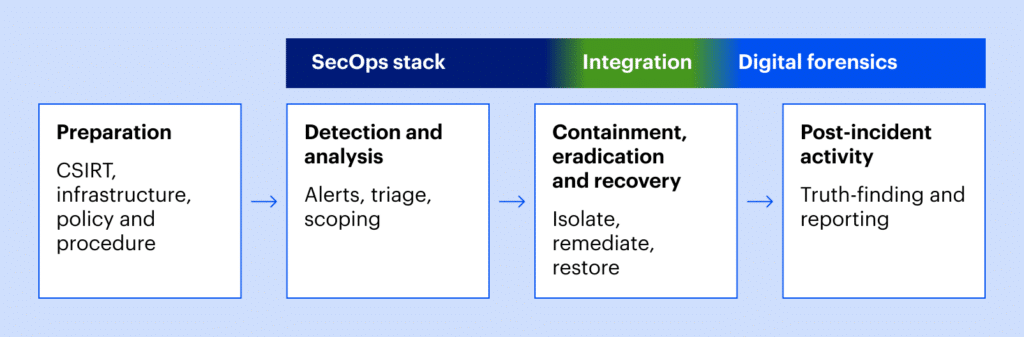
The result is that post-incident investigations end up being slow, costly, or incomplete:
- Slow when by the time the team circles back to a closed ticket, the evidentiary logs have rolled over.
- Incomplete when reports get filed on inference rather than evidence, and the questions auditors or insurers will ask later don’t have answers.
- Costly when the same attack works again because root cause was never established.
2. Even when teams do spend time on phase four, detection tools weren’t designed to give them what it requires.
EDR and XDR excel at monitoring activity in real time and recording what they are observing. They aren’t designed to reconstruct months or years of historical attacker activity or preserve the complete evidentiary record needed for investigation.
Today’s attackers move quietly via stealthy credential abuse and living-off-the-land techniques that don’t trip alerts but still persist as forensic artifacts — registry entries, scheduled tasks, account changes, application event logs, memory residue. These artifacts often sit outside the scope of what detection tools are built to capture or retain long-term.
5+ years
How long state-sponsored attackers maintained undetected access inside U.S. critical infrastructure.
CISA, NSA, and the FBI found that PRC state-sponsored actors known as Volt Typhoon had persisted inside critical infrastructure networks for at least five years, using living- off-the- land techniques and valid credentials to blend in with normal activity and evade detection.

There’s also a quieter cost to skipping the forensic layer. When incident response teams attempt deep dive investigation without specialized tools, they can inadvertently destroy the evidence they’re trying to preserve. Internal teams without forensic training can accidentally alter or overwrite data during collection, producing a record that won’t hold up under audit, litigation, or insurance review. Regardless of careful evidence handling, data can disappear on its own quickly. Routine system behavior like reboots, log rotation, and automated cleanup ages out data over time, and attackers actively destroy evidence on the way out to erase traces of what they did.
Forensic collection isn’t just about getting the right data. It’s about getting it before something else gets to it first.
The questions threat detection and response solutions can’t answer
Once the immediate threat is contained, incident response teams start getting asked questions that detection tools can’t answer on their own:

If your team can’t answer these questions with confidence after an incident, you have an investigative gap. The good news is there’s a clear way to close it.
How digital forensics closes the incident response gap
Digital forensics is the investigative layer that closes the gap. It introduces purpose-built tools and workflows for evidence collection, reconstruction and validation — capabilities traditional detection tools were not designed to provide.
It enables the deep analysis that leads to root cause — what happened, how, and why — and reconstructs the full historical record of an attack.
And it’s faster than its reputation suggests. Slow, image-the-entire-drive forensics is a thing of the past. Today’s modern solutions are targeted: collect what matters — memory, the specific artifacts, the relevant cloud and identity data — and trigger that collection automatically the moment an alert fires, so the evidence is preserved before it disappears. Evidence collection can happen during the response itself, so by the time analysis begins, the data is already preserved and processed.
Forensic solutions don’t replace the tools organizations and agencies already rely on. They integrate with the existing stack, completing a critical part of incident response that’s often left unfinished.
This reflects how mature DFIR teams operate today. Detection tools surface incidents. Forensic tools validate scope, reconstruct attacker activity, and preserve defensible evidence. The two work together — and the integration is what produces the full picture.
That full picture is what turns a closed ticket into a confident decision. When a team knows what happened, how, and why — with evidence behind it — they can scope remediation accurately, answer to regulators and legal with certainty, and decide what to do next without guessing. It’s the difference between “we contained it” and “we contained it, we know how they got in, and we stopped the chance of it being repeated.”
Why incident response now requires defensible investigation
There are three forces converging that make the investigative gap between detection and answers more urgent — and more expensive to leave open than ever before.
Regulators and insurers are raising the bar.
Regulators and oversight bodies that used to ask, “did you contain it?” are now asking, “can you prove what happened, with evidence?”
In 2023 the U.S. Securities and Exchange Commission began requiring public companies to disclose material cybersecurity incidents — including the nature, scope, and timing of the incident — on a Form 8-K within four business days of determining the incident is material. Cyber insurers, meanwhile, increasingly expect evidence of a tested response capability before they’ll provide coverage. Meeting either bar depends on being able to establish scope and impact quickly and defensibly, which is forensic work.
Across both private and public sectors, the expectation is shifting from simply containment to defensible investigation.
Attacks are moving faster
AI-generated attacks are compressing the window between intrusion and execution. Phishing and business email compromise campaigns are more convincing, harder for email filters to catch, and harder to attribute after the fact. As attacks move faster, so do response and remediation actions — reducing the time available to collect and preserve evidence before logs rotate, systems reboot, or critical data is overwritten.
That’s why forensics readiness is a process that needs to be built in advance — not after an attack is over.
55%
of DFIR professionals say AI-powered attacks are making cyberattacks more challenging to investigate.

Unknown threats need deep forensic analysis
AI-assisted tools have lowered the barrier to creating novel attacks. Attackers with no specialized expertise can now generate code that exploits vulnerabilities in ways defenders haven’t seen before — meaning more zero-day attacks reaching more environments, faster.
A zero-day, by definition, is an attack defenders have had zero time to prepare for. There’s no patch, no signature, no detection rule. The conventional cybersecurity stack can’t catch what it doesn’t recognize. The only way to understand a novel attack is to take it apart afterward and learn from it — establishing how it got in, what it did, and how it bypassed defenses. Done well, that analysis feeds back into detection, so the second instance of the same attack gets caught.
For incident response teams, the takeaway is that the conditions are shifting in a specific, practical way: more attacks, moving faster, and a growing share novel enough that detection rules won’t flag them on the first pass. That’s exactly where digital forensics becomes essential.
The Mythos signal
One clear signal of where this is heading came in April 2026, when Anthropic disclosed a frontier AI model, Claude Mythos Preview, limiting access to a vetted group of technology and security firms rather than releasing it broadly — because its ability to find software vulnerabilities was significant enough to be dangerous in the wrong hands. What’s notable for defenders isn’t any single capability but the shift it represents: AI agents can now find weaknesses across widely used software at a speed and scale beyond human teams, and with far less specialized expertise than that work used to require.
How digital forensics extends each layer of the cybersecurity stack

EDR & XDR
EDR flags suspicious activity on a host. From there, forensic tools go further — enabling targeted artifact collection, memory capture, and remote triage that focus on what matters rather than imaging everything.
Analysis surfaces persistence mechanisms and attacker behavior that monitoring tools were never designed to collect.
Containment decisions can then be validated with preserved evidence, increasing confidence that the attacker is removed — not waiting behind an undiscovered foothold.
→ The handoff: EDR detects → forensics scopes, finds persistence, confirms eradication.

SIEM
The SIEM has the telemetry — endpoint, network, cloud, identity — and the correlations across them. Forensics joins that telemetry to file system, memory, and host artifacts so the attack chain comes together as a single, defensible timeline instead of a stack of related alerts. Root cause analysis stops being a guess.
→ The handoff: SIEM correlates → forensics reconstructs the chain into a defensible timeline.

SOAR
SOAR runs the playbook. Integrated with digital forensics, it can trigger automated evidence collection the moment an alert fires — before reboots, log rotation, or remediation actions destroy critical data.
This closes the gap between “alert” and “investigation,” where time and evidence are most often lost.
→ The handoff: SOAR triggers → forensics collects automatically before evidence disappears.
What digital forensics in IR looks like in practice
When digital forensics is built into incident response workflows, it changes how an investigation starts and unfolds.
A user clicks a malicious link in a phishing email and downloads what looks like an approved tool but turns out to be malware. EDR fires on the suspicious behavior. SIEM correlates the alert with anomalous logins and mailbox activity from earlier in the week. SOAR — when integrated with digital forensics workflows — triggers remote collection of memory, endpoint artifacts, mailbox data, cloud logs — before reboots, log rotation, or remediation actions can overwrite or destroy any critical data.
In well-integrated environments, by the time the analyst sits down, the evidence is already preserved, triaged, and awaiting analysis. The investigation reconstructs what the attacker accessed, what data was accessed or exfiltrated, and what persistence was established — producing findings that are defensible.
The team didn’t replace its EDR, SIEM, or SOAR. It made every one of them more effective by adding digital forensics — the investigative layer for evidence collection, reconstruction, and validation.
What forensic solutions deliver
What integrating digital forensics with the rest of your security stack delivers:
- Rapid triage and response. Validate alerts from other systems with forensic context, and preserve the chain of custody from the moment an investigation begins.
- Deep investigation. Reconstruct the full attack timeline, identify root cause and persistence, extract IOCs and TTPs, and produce evidence that holds up to scrutiny.
- Remediation and hardening. Translate root-cause findings into targeted fixes. Verify that persistence is gone. Validate remediation with evidence, not assumption.
- Continuous improvement. Feed vetted IOCs, TTPs, lessons learned, and improved detection rules back into the rest of the stack — so the same attack doesn’t work twice.
- Forensic readiness. Build the proactive posture regulators, insurers, and oversight bodies increasingly expect — so when the next incident hits, the playbook for evidence preservation and defensible investigation is already in place.
Alerts tell you that something happened. Digital forensics tells you what happened, how, and why, with evidence that stands up to scrutiny. It doesn’t replace what your team already runs; it adds the investigative layer that finishes what detection starts. That’s the full picture — and the difference between stopping an attack and fully understanding it.
Learn more about digital forensics solutions
See how Magnet Forensics adds the investigative layer to the stack you already run — so your team can resolve every incident with confidence.
For federal agencies: Explore federal cybersecurity and DFIR solutions
For private organizations: Explore incident response solutions