



Bridging cybersecurity & forensics: Why DFIR belongs inside the modern SOC
Authored by Doug Metz
Originally published in the November 2025 issue of Magnet Unlocked. Want to be the first to see new content? Sign up for our monthly newsletter, Magnet Unlocked.
In many corporate environments, cybersecurity and DFIR still operate in separate lanes:
SOC = Detection & containment
DFIR = Evidence & root cause
That separation made sense years ago, but it doesn’t anymore.
Attackers rely on our internal silos.
We need to close that gap.
A modern SOC cannot succeed without DFIR and modern DFIR cannot succeed outside the SOC.
The future belongs to detection teams with investigative depth and forensic teams empowered from minute zero. That’s how you build a security program ready for today’s adversaries—and tomorrow’s.

Why separation no longer works
Modern attacks move too quickly, cloud environments generate too much telemetry, and regulators expect detailed timelines while you’re still fighting the fire. When DFIR is brought in after containment, critical evidence is gone—memory, cloud logs, lateral movement artifacts—and investigations start at a disadvantage.
Here’s the shift happening across the industry:
DFIR is moving from “after-action” to “minute zero.”
Forward-leaning organizations are embedding DFIR directly into the SOC so that:
- Volatile evidence is captured early
- Timelines are built in real time
- Root cause is discovered faster
- Reporting is defensible for legal/regulators
- Cloud, identity, and endpoint telemetry tell one unified story
This isn’t theory. It’s becoming a competitive necessity.
The problem with the old model
When SOC acts first and DFIR arrives later, teams commonly lose:
- RAM artifacts
- Cloud audit windows
- Identity traces
- Container logs
- Flow/PCAP slices
- Evidence needed for insurance & compliance
Why it matters to the business
Integrated SOC + DFIR delivers:
- Faster investigations
- Stronger evidence integrity
- Better cyber-insurance posture
- Reduced regulatory risk
- Accurate root-cause analysis
- Cleaner remediation
- Stronger executive confidence
Cybersecurity is moving from “alert-driven” to investigation-driven. Organizations who don’t evolve will struggle to answer the most important question: “What actually happened?”
What integration looks like
Detection → SOC triage → Immediate forensic capture → Containment → DFIR timeline & RCA
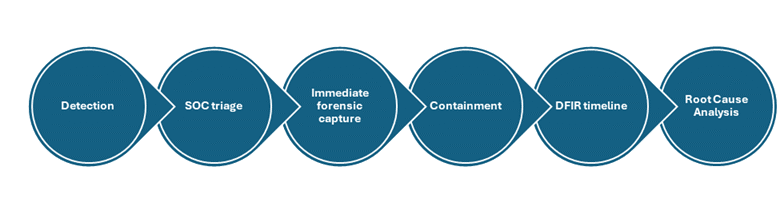
These activities overlap. Evidence collection begins during triage, not after containment.
Examples of what this enables:
- High-severity EDR alerts auto-trigger memory collection
- Cloud IAM anomalies automatically snapshot workloads
- Exfiltration alerts pull pcaps/flow data instantly
- DFIR and SOC share a single case timeline
This is forensic readiness: pre-positioned tooling, documented procedures, trained personnel, and clear escalation paths—all in place before an incident occurs.
What “forensic readiness” actually means
It’s not just fast response. It’s infrastructure built to preserve evidence by default:
- Pre-positioned tooling (agents, collectors, retention policies in place)
- Documented procedures (playbooks that define what to capture, when, and how)
- Trained personnel (SOC analysts who know when to escalate, DFIR teams embedded in workflow)
- Clear escalation paths (no guessing who owns the handoff or when to pull the trigger)
When an incident hits, you’re not scrambling to figure out how to collect evidence. You’re executing a plan that was ready on day zero.
The reality: Why this Integration is hard
Let’s be honest, merging SOC and DFIR isn’t a policy change. It’s organizational surgery.
Common obstacles include:
- Cultural friction: SOC teams are trained to move fast and contain. DFIR teams are trained to preserve and document. Those instincts conflict. Integrating them requires deliberate culture-building, not just a new org chart.
- Tooling gaps: Most organizations have EDR, SIEM, and case management systems that don’t talk to each other. Auto-triggering forensic collection on high-severity alerts sounds great — until you realize it requires custom integrations, API work, or expensive orchestration platforms.
- Staffing constraints: DFIR practitioners are already in short supply. Embedding them in 24/7 SOC operations means either hiring (expensive, slow) or cross-training SOC analysts in forensic principles (time-intensive, requires buy-in). Many orgs don’t have the runway for either.
- Data volume & cost: Capturing memory on every Tier 1 alert, retaining cloud audit logs beyond standard windows, or pulling full PCAPs creates storage, processing, and licensing costs that weren’t in this year’s budget. Finance will ask hard questions.
- Runbook maturity: Integration only works if everyone knows when to escalate, what to preserve, and who owns the handoff. Most organizations don’t have those playbooks written, tested, and rehearsed.
The good news? You don’t have to solve all of this at once. Start with high-fidelity alerts, one forensic capture workflow, and a single shared timeline tool. Build incrementally. Prove value. Expand from there.
Perfect integration is a multi-year journey. Functional integration can start next quarter.