North Richland Hills PD reaches encrypted vehicle data other tools couldn’t with Magnet Autokey
“(Autokey) fills in a gap we don’t have a solution for… and that data may be absolutely crucial.”

Key insights
- The challenge: Legacy vehicle solutions and chip-off extractions didn’t offer a way to access encrypted vehicle data, leaving a hit-and-run suspect’s truck out of reach for two years.
- The solution: Working with the Magnet Autokey team, the North Richland Hills PD lab quickly extracted encrypted data from the truck’s infotainment module without a chip-off, processing and analyzing the vehicle evidence with their Magnet toolkit.
- The impact: By recovering previously unobtainable data, the investigative team had a more complete view of the available evidence in the case and opened vehicle exams to more investigations, not just high-profile cases.
Vehicle evidence sits out of reach
The case was a fatal hit-and-run: a 16-year-old was walking home from a concert, when the alleged driver went through construction barriers, struck the teenager, and didn’t stop.
The North Richland Hills Police Department seized the suspect’s mobile phone and vehicle — a GM truck. That posed a problem, said Erik Whitlock, one of two digital forensics examiners for the unit. The in-house lab’s existing tool didn’t support the vehicle and a chip-off wasn’t an option either. The data was encrypted and pulling the chip would cut its link to the hardware security.

Any time you need to remove the infotainment unit or conduct a full chip-off the process is time-consuming and labor intensive, especially for certain vehicles, Whitlock added. “You are ripping out dashboards, breaking clips, and there is a liability element that police departments have.” For many vehicles, the module sits under the passenger footwell that can take hours to remove, often in the Texas heat.
“(Our existing tool) has definitely lacked when it comes to dealing with those types of modules.”
As a result, the lab examines vehicles for only the most serious cases — like the hit-and-run. “Once you do the chip-off, there’s no going back,” Whitlock related. “So, I chose not to do that. I chose just to wait, and maybe we’ll find a solution one day.”
Examiner finds a way in
After two years of waiting and with the trial set to begin in two months, the irreversible chip-off looked like Whitlock’s only option.
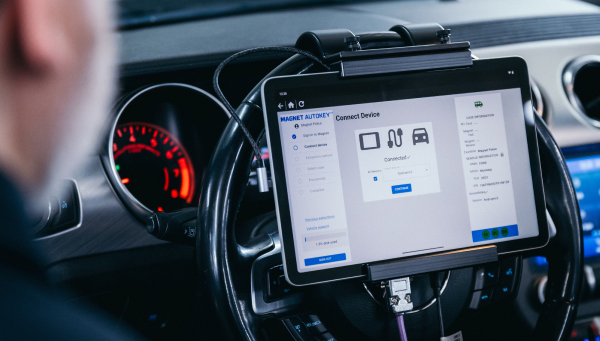
Then, at a digital forensics conference, he stopped by the Magnet Forensics booth to ask about Magnet Autokey, a new tool for encrypted vehicle systems. They checked the truck’s make and model and it was supported.
The North Richland Hills department has worked with Magnet since before Whitlock joined the lab. Magnet Graykey handles the vast majority of the iPhones coming into the lab and a significant portion of its Android devices. The team also use Graykey to preserve Apple device data that expires naturally over the course of days or weeks. They then turn to Magnet Axiom to support deep analysis and share portable cases with detectives.
Working with the Autokey team, the lab extracted user data from the truck’s encrypted module — without the chip-off. The data showed the suspect’s phone had been connected to the truck.
“(Autokey) got stuff that was — up to that point — unobtainable.”

The experience showed Whitlock what vehicle exams can look like. Instead of taking dashboards apart, examiners can simply plug in, much as they already do with Graykey. Whitlock sees that approach as substantially better for both time and liability.
“It’s going to be an easier process,” he said. “It fills in a gap we don’t have a solution for… and that data may be absolutely crucial.”
Lab widens vehicle exams
For the hit-and-run, the user data didn’t decide the case, but it didn’t need to. Just accessing the data was a huge victory, Whitlock said.
The non-invasive access to vehicle evidence also strengthens the examiner position in court, he noted. Defense attorneys often question examiners on what they aren’t able to do. Having examined the truck’s data leaves “one less thing they can call into question,” Whitlock related.
The bigger change is what the lab can take on next. Up until now, vehicle exams were saved for only the most serious cases. When a detective asks for vehicle data on something like an auto theft, the examiners must weigh whether it’s worth the time and effort of a hands-on process. Often it isn’t.
Whitlock said a plug-in workflow with Autokey changes things.
“That could increase the volume of what we do on the cars that are not as high profile.”
Vehicle data no longer has to be reserved for homicides. Offenses like auto theft and reckless driving, can get the same range of data as high-profile cases. With Autokey, the lab can fulfill more requests by detectives. And, for Whitlock, that ties back to his motivation to follow the evidence, wherever it leads.
“I care about how I can help push a case forward and ensure that we have the right person or we don’t have the right person,” he said. With Magnet tools across phones, computers, and vehicles, the lab has more ways to reach that answer.
A summary of what changed and why it matters.
Encryption blocks vehicle evidence
Newer vehicles protect data much like smartphones which legacy solutions can’t access. Teardowns take time and carry liability, so many labs save vehicle exams for only their most serious cases.
Access without a chip-off
Magnet Autokey reaches encrypted vehicle data without destroying the path to decryption. Accessing data directly through the USB port, eliminating the need for disassembly and saving hours of examiner effort.
More cases, fewer gaps
With vehicle data easier to reach, labs can act on more detective requests and leave fewer gaps for the defense. That means following the evidence wherever it leads.


Similar success stories



See how Magnet Autokey can help your lab reach encrypted vehicle data without a chip-off.
Contact Magnet Forensics today.